
Why your shield needs to survive cluster shots
ASTM Series Part 2: Cluster Shot Testing
The assumptions built into most ballistic shields
When a ballistic shield is tested under the NIJ 0108.01 standard, five test rounds are spread across the strike face, where each shot must be at least two inches from the shield edge and no closer than two inches to any other shot. If none of the five shots perforate, the shield passes.
That protocol is logical for what it was designed to do: assess whether a ballistic material can stop a bullet. But NIJ 0108.01 was not written to qualify ballistic shields carried by law enforcement officers, and it shows. The problem is that the NIJ standard assumes that rounds will only be aimed at the strongest part of the shield and will be nicely spread apart from one another.
Why cluster shot testing reflects real engagement conditions
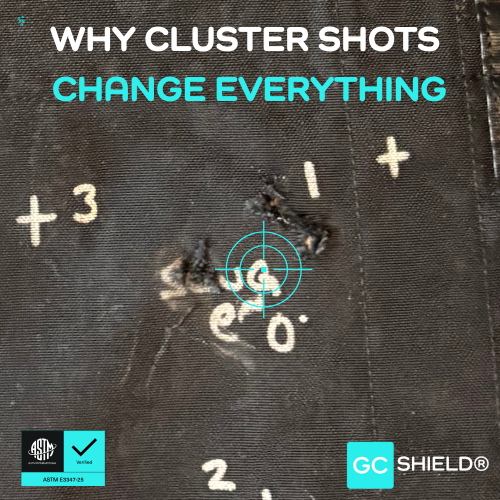
ASTM E3347-25 was developed with direct input from SWAT and military professionals who understand how shields are carried and used in real operations. The requirement to test three rounds within a 4-inch diameter circle reflects that operational reality. It’s not a theoretical scenario, it’s a recognition that impacts in real engagements are not evenly distributed across a shield face.
Data from 25 years of active shooter events shows that at least one officer was shot in 72 out of 597 incidents (approximately one in eight) with 142 officers shot in total across those events. Research on officer-involved shootings consistently shows that multiple rounds are fired in real engagements: officers are trained to fire until a threat is terminated, and hit rates in real incidents average around 35%, meaning several rounds are typically fired before contact is made. A shield in those conditions is not absorbing one well-placed shot and then standing down. It’s operating in a sustained, high-stress exchange where repeated impacts are the realistic scenario.
The question ASTM E3347-25 asks is therefore the right one: not whether a shield can stop a single round on a fresh, undamaged surface, but whether it maintains integrity after multiple impacts in close proximity, where each round arrives on a surface already distressed by the last.
What NIJ testing does (and doesn’t) address
NIJ 0108.01 requires five shots per test threat, with those shots spaced to avoid any interaction between impact zones. The logic is sound for materials testing. You want to know whether the material itself can stop a round, without the complication of one impact affecting the integrity of the zone next to it.
But that same logic means NIJ testing deliberately avoids testing what happens when rounds land close together, which is precisely what’s likely to occur in a real engagement.
There’s no requirement under NIJ to test whether a second or third impact in the same area compromises the shield’s performance. So a shield can be NIJ rated and never have been tested for that scenario.
What ASTM E3347-25 requires
ASTM E3347-25 intentionally closes this gap. The ASTM standard requires that a shield withstands four sets of cluster shots per test threat, where a cluster shot consists of three rounds landing within a 4-inch diameter circle. With a cluster shot, each successive impact potentially interacts with the damage caused by previous rounds in the cluster.
This is a fundamentally different test from NIJ. It’s not asking whether a fresh, undamaged section of the shield can stop a single round. Instead, it’s demanding to know whether the shield maintains integrity after repeated, concentrated impacts on the same area, a scenario which is much more like what officers face.
In addition, the ASTM standard was specifically designed for assessing the performance of ballistic shields, requiring a minimum number of shots on each area of a shield while suspended by its handles, a significant step forward from the NIJ standard, developed for ballistic panels, rather than complete ballistic shield systems.
This cluster shot test also happens only after the shield has been subjected to the environmental conditioning covered in Part 1 of this series (extreme temperature exposure and water immersion). So the shield being tested isn’t fresh out of the box at room temperature: It’s a shield that replicates the conditions of real-world storage and deployment.
How GC Patrol Shield performs
GC Patrol Shield passed ASTM E3347-25 and its rigorous cluster shot testing in November, 2025, with the testing performed by an independent ISO-qualified third-party laboratory that is also qualified by NIJ. GC Patrol Shield’s passing test result was verified by the Safety Equipment Institute, a non-profit subsidiary of ASTM International, that verifies and certifies safety and protective products. GC Patrol Shield was the first rifle shield to be verified to the ASTM standard and remains the only rifle shield to be verified for both rifle and shotgun rounds (RF1 and SG).
That verification was achieved with the same commercial product GC Patrol Shield has been selling in the market since early 2024, with no modifications or upgrades to pass. The ASTM verified GC Patrol Shields that agencies are purchasing today are the same design and manufacture as the GC Patrol Shields that have been sold for the last two years.
At 20 lb, GC Patrol Shield is also lighter than comparable rifle-rated and shotgun-rated shields. That matters in the cluster-shot context in a way that’s easy to overlook: a lighter shield is more maneuverable, a shield an officer can hold steady, move with, and maintain in position under sustained fire. Any shield that eventually passes cluster-shot testing but is significantly heavier creates its own operational problems for the officer.
What this means for procurement decisions
When your agency evaluates a ballistic shield, the NIJ rating tells you the material can stop a specified round under optimal conditions. The NIJ rating does not tell you what happens on the second or third impact in the same area. ASTM E3347-25 cluster-shot testing tells you the real story. It’s the difference between knowing whether a shield is only a fair weather friend or is a winter soldier that will stand by you in the conditions you have to face, day in and day out.
Next month: Part 3 examines edge shot testing. What happens when rounds strike the perimeter of a shield? Why is the gap between NIJ and ASTM testing most pronounced at the edges?
Sources
- ASTM E3347/E3347M-25 Standard Specification for Ballistic-Resistant Shields Used by Law Enforcement Officers — https://store.astm.org/e3347_e3347m-25.html
- ASTM International — Increasing Confidence in the Performance of Ballistic Shields — https://www.astm.org/news/ballistic-shields-tactical-safety-standards
- ALERRT / Texas State University — 25 Years of Data on Officers Shot During Active Shooter Events — https://tacticalscience.substack.com/p/25-years-of-data-on-officers-shot
- Police1 — Ballistic shields must match escalating firepower — https://www.police1.com/police-products/tactical/ballistic-shields/ballistic-shields-must-match-escalating-firepower
- FBI Law Enforcement Bulletin — Active Shooter Events from 2000 to 2012 — https://leb.fbi.gov/articles/featured-articles/active-shooter-events-from-2000-to-2012/view
- Donner & Popovich / CNN — Officer shooting accuracy research (Dallas PD, 35% hit rate) — https://edition.cnn.com/2020/08/26/us/why-police-shoot-so-many-rounds-trnd