
Edge Shots: What your rating doesn’t tell you
ASTM E3347-25 Series — Part 3: Edge Shot Testing
The gap NIJ testing leaves open
NIJ 0108.01 has a concept called a ‘fair hit.’ For a shot to count as a fair hit it must land at least two inches from the shield’s edge. Did you know a round that strikes within the two-inch perimeter is classified as an ‘unfair hit’ and a perforation in this area does not disqualify the shield?
Read that again. Under NIJ testing, a round that passes through the shield within two inches of the edge does not cause the shield to fail.
The logic behind this is the same materials-science reasoning that shapes the rest of the NIJ standard: testing is designed to evaluate the central ballistic panel, and shots too close to the edge introduce variables such as delamination, edge geometry, fastener proximity. These issues complicate the picture, and under NIJ, edge shots simply don’t count.
The problem is that edge shots happen. An officer advancing on a barricaded subject doesn’t control where the rounds go. A subject who can see any part of a shield will fire at it. The edges are always in play.
Why edges are a vulnerability
The edge of a ballistic shield is where the engineering gets harder. The central strike face of a well-designed shield is its strongest point, layers of material working together across a large uninterrupted area to absorb and distribute impact energy. Towards the perimeter, that behavior changes, introducing challenges such as penetration, ricochet and spalling. The material is constrained, and the ability to distribute energy across the panel is reduced.
For shields that incorporate edge trims, binding materials, or attached hardware, all common design elements, the perimeter is also where different materials meet. Joints between dissimilar materials under ballistic impact behave differently to a homogeneous panel under the same conditions.
The consequence is not theoretical. As Ron Tetreau, a 30-plus-year law enforcement, military veteran and former SWAT team leader, observed after live edge shot testing: “If you did this with a conventional shield, you would see perforations, which could severely injure the shield operator, not to mention spalling or bullet ricochet, which could severely injure anyone near the shield.”
Spalling (fragmentation of the shield surface caused by impact) is a secondary hazard that NIJ testing does not address at all. A round that strikes the perimeter of a shield and causes spalling can injure the shield operator or nearby officers even if it does not fully perforate. Under NIJ, that outcome is invisible to the standard.
What NIJ testing does (and doesn’t) address
Under NIJ 0108.01, shots must land at least two inches from the shield’s edge to qualify as fair hits. Any round striking within that zone is an unfair hit, and any perforation from an unfair hit carries no consequence for the shield’s rating.
This means a shield can carry a full NIJ rating without ballistic testing a round that strikes its perimeter. The standard that agencies rely on to make procurement decisions does not address one of the most operationally significant failure scenarios a shield can face.
What ASTM E3347-25 requires
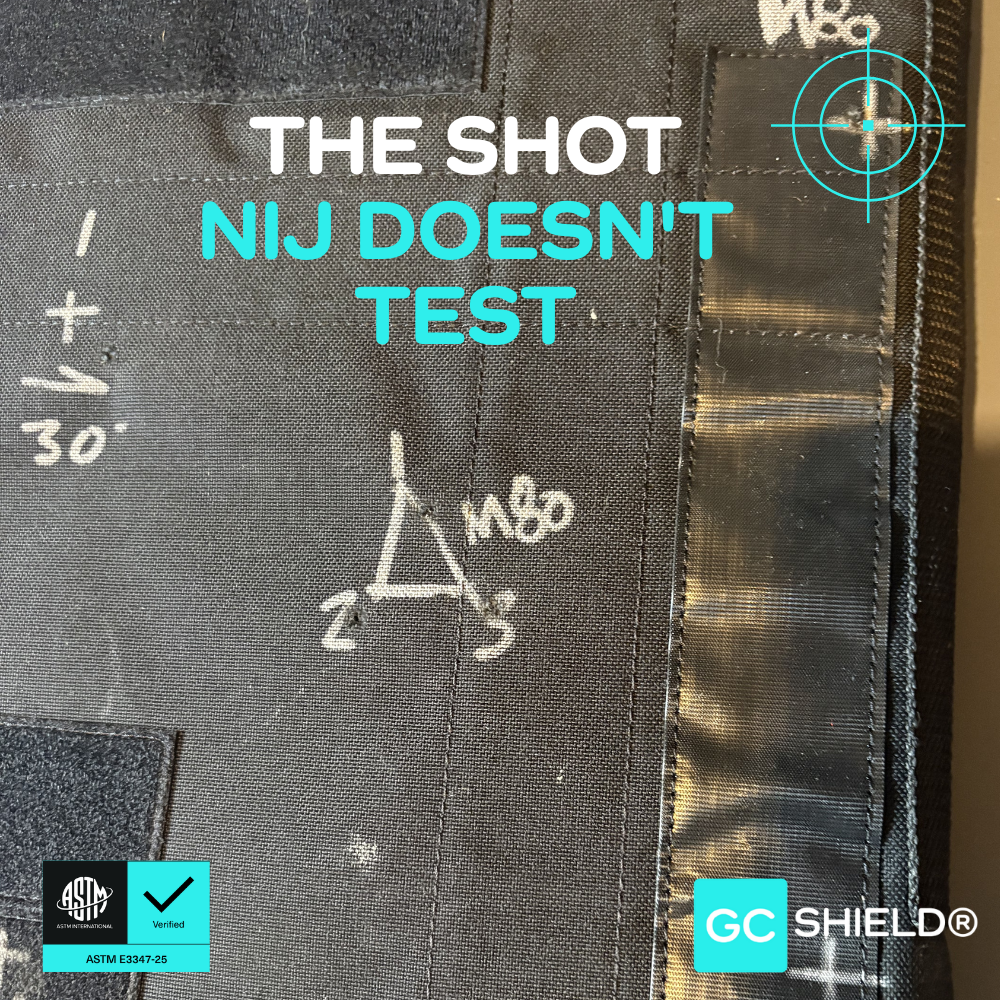
ASTM E3347-25 however, does address this directly. The ASTM standard maintains the same two-inch shot-to-edge tolerance as NIJ, but then mandates testing of Edge Shots, which it defines as the area less than an inch beyond that perimeter. Per ASTM, Edge Shots are those right next to the zone that NIJ classifies as unfair hits, an area that NIJ disregards entirely. Under NIJ, there is no discussion of such Edge Shots. Under ASTM, Edge Shots are required test shots.
Equally important is when that testing takes place. ASTM edge shot testing, like all ASTM E3347-25 testing, occurs after the environmental conditioning covered in Part 1 of this series (extreme temperature cycling and water immersion) and may follow the cluster-shot testing covered in Part 2. The shield arriving at edge shot testing is not fresh from the factory. It has already been subjected to the conditions of real-world storage and deployment, and potentially sustained concentrated fire. That makes passing significantly harder, and the verification significantly more meaningful.
How GC Patrol Shield performs
GC Patrol Shield passed ASTM E3347-25 edge shot testing in November 2025, with testing conducted by an independent, ISO-qualified third-party laboratory who are also qualified by NIJ, with the results subsequently verified by Safety Equipment Institute (an ASTM Affiliate).
That result was confirmed by Ron Tetreau during live testing: “We had a precision marksman shooting right to the edge of the GC Patrol Shield, and it still gave a full level of protection.”
GC Patrol Shield is also the only shield to have achieved ASTM E3347-25 verification at SG (shotgun) level. Rifle-rated protection typically commands the most attention in procurement conversations, and rightly so, but shotgun threats remain a real operational scenario, and no other shield has been verified against ASTM E3347-25’s shotgun standard. That is not a minor footnote. It means GC Patrol Shield has been tested and verified across a broader threat range than any other ASTM-verified shield on the market.
Critically, GC Patrol Shield contains no transparent viewport, a design element common in many shields that introduces one of the most frequently cited perimeter vulnerabilities. Viewports require their own edge sealing, bonding, and transition materials, each of which represents a potential weak point under edge shot conditions. By eliminating the viewport entirely, GC Patrol Shield removes that category of edge vulnerability from the equation.
The verification was achieved with the same GC Patrol Shield commercial product that GC Shield has been selling in the market since early 2024, with no modifications. The ASTM-verified shields agencies are purchasing today are the same design and manufacture as the GC Patrol Shields that have been sold for the last two years.
What this means for procurement decisions
When your agency evaluates a ballistic shield, the NIJ rating tells you what the central strike face can stop under controlled conditions. It tells you nothing about what happens when a round strikes the perimeter, because NIJ testing doesn’t go there.
ASTM E3347-25 edge shot testing mandates that some test shots must strike as near to that unfair hit perimeter as possible. It’s the difference between a shield rated for the shots the standard expected, and a shield verified for the shots that actually happen.
There is one further question worth raising with any supplier. ASTM E3347-25 has been available for verification for over six months. In that time, only two rifle-rated shields have passed, one of them GC Patrol Shield. If your agency is currently carrying a different shield, it is a reasonable question to ask whether it has been submitted for ASTM E3347-25 verification, and if so, what the outcome was. If it hasn’t been submitted, it is worth asking why. The standard exists. The testing is available. The results speak for themselves.
Next month, Part 4 examines weak point testing – handle mounts, attachment hardware, and the structural elements of a shield that standard testing has never been required to address.
Want to hear more from Ron Tetreau? He joined the Shots Fired podcast with GC Patrol Shield to talk ballistic shield performance and what really matters for officer protection. Watch the full episode here.
Sources
- ASTM E3347/E3347M-25 Standard Specification for Ballistic-Resistant Shields Used by Law Enforcement Officers — https://store.astm.org/e3347_e3347m-25.html
- ASTM International — Increasing Confidence in the Performance of Ballistic Shields — https://www.astm.org/news/ballistic-shields-tactical-safety-standards
- Police1 — Raising the bar: GC Patrol Shield becomes first rifle shield to pass new ‘real-world’ ballistic standard — https://www.police1.com/police-products/tactical/ballistic-shields/raising-the-bar-gc-patrol-shield-becomes-first-rifle-shield-to-pass-new-real-world-ballistic-standard
- Police1 — Ballistic shields must match escalating firepower (Tetreau quotes, spalling) — https://www.police1.com/police-products/tactical/ballistic-shields/ballistic-shields-must-match-escalating-firepower
- Police1 — Why ballistic shield standards are getting a closer look — https://www.police1.com/police-products/tactical/ballistic-shields/why-ballistic-shield-standards-are-getting-a-closer-look