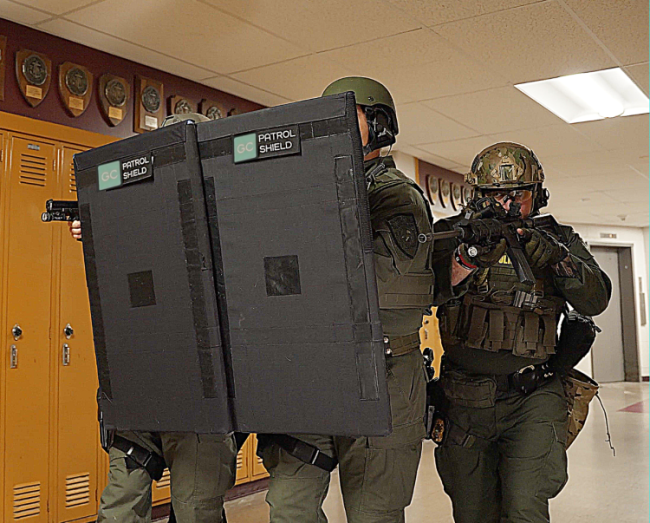
“How Long Will This Shield Last?” Why Warranty and Lifecycle Matter in School Procurement

A 10-year warranty, double the industry standard, changes the total-cost-of-ownership for school procurement.

For School Procurement & Budget Officers | District Administrators
TL;DR:
  • When evaluating a ballistic shield warranty for schools, GC Patrol Shield’s 10-year term, double the industry standard, is a procurement-relevant fact, not a footnote.
  • Over a 10–20 year planning horizon, warranty length changes the total cost of ownership: fewer replacement cycles and more budget certainty.
  • A longer warranty is also a confidence signal. Reflecting the manufacturer’s confidence in long-term material and ballistic performance.
  • Schools evaluating ballistic shields should request warranty terms in writing, along with the testing basis behind them.
  • A defensible procurement decision documents warranty length alongside standards compliance, third-party verification, and fitness for purpose.

1. Warranty deserves more than a spec-sheet line

Warranty length is typically listed as a single line on a ballistic shield spec sheet, alongside weight and rating. For a piece of safety equipment a school expects to keep in service for a decade or more, that treatment understates what the warranty term represents.

GC Patrol Shield’s 10-year warranty, double the industry standard, should be a procurement consideration at the same level as the NIJ rating because it directly shapes how long the equipment is expected to perform and when it needs to be replaced.

What to know: Warranty length is a planning variable, not a footnote. It belongs in the same evaluation step as standards compliance and verification. Not as a separate, lower-priority consideration.

2. What a 10-year warranty signals

A warranty term reflects how confident a manufacturer is in the long-term performance of the materials and construction behind it. GC Patrol Shield’s 10-year warranty is backed by the same graphene composite construction, NIJ Level III+ rating, and ASTM E3347-25 verification that define the product itself.

A shorter warranty term is not inherently disqualifying, but it is a data point worth weighing against the rest of a vendor’s verification record. A longer warranty term, backed by independent verification, is a stronger signal than a long warranty term alone.

What to know: Warranty length and independent verification reinforce each other. GC Patrol Shield’s 10-year warranty is paired with ASTM E3347-25 verification. The warranty term and the testing record both point the same direction.

3. Modeling total cost of ownership over a 10–20 year horizon

School security budgets are typically planned in multi-year cycles, often 10 to 20 years for capital safety equipment. Warranty length is one of the clearest levers on that calculation: a longer warranty means fewer replacement cycles across the same planning horizon, which means fewer line items competing for the same budget years out.

Run the comparison directly: across a 20-year horizon, a shield backed by a 10-year warranty needs one replacement cycle to stay within warranty coverage. A shield with a shorter warranty term needs more, each one a fresh procurement cycle, a fresh budget request, and a fresh administrative process.

What to know: Warranty length is a multiplier for the total cost of ownership calculation, not just a comfort factor. The longer the warranty, the fewer replacement cycles a district needs to plan and budget for across the same equipment lifespan.

4. What to ask vendors

A defensible procurement record asks for warranty terms in writing, not just a verbal assurance, and asks what stands behind those terms.

  • What is the warranty term? Get the number in the procurement documentation, not just a sales conversation.
  • What testing record backs the warranty term? A warranty backed by independent verification (such as ASTM E3347-25) carries more weight than a warranty term alone.
  • Is the verification product the same product sold commercially? A warranty on a test sample that differs from the commercial product is a different commitment than a warranty on the unit a district purchases. GC Patrol Shield’s ASTM E3347-25 verification was conducted on the same commercial product sold since early 2024, no modifications were made for testing.

What to know: Warranty terms should be documented in writing and weighed against the independent testing record behind them, not treated as a marketing assurance separate from the verification process.

5. Where this fits in a defensible procurement decision

Warranty length belongs alongside standards compliance, third-party verification, and fitness for purpose make a school procurement decision defensible whether that be to a school board, a funding body, or in the event the equipment is ever called into question. Our school security planning and duty of care page covers the full governance framework these factors sit within or read our full four-criterion buying checklist for schools.

What to ask: Does the procurement record document warranty term, testing basis, and verification status together or only the upfront purchase price? A defensible decision documents all of them.

6. How to use this in practice

For budget officers:

  • Model total cost of ownership across the full planning horizon, factoring warranty length into the number of replacement cycles required.
  • Request warranty terms in writing as part of the vendor comparison, not as an afterthought to price.

For administrators:

  • Document warranty term alongside standards compliance and verification record in the procurement file, this is what makes the decision defensible later.
  • Ask whether the warrantied product matches the commercially sold product, not a test sample.

For procurement teams:

  • Treat warranty length as a planning input on par with weight, price and rating when comparing ballistic shield vendors.
  • Pair warranty comparisons with each vendor’s independent verification record, the two together are the strongest signal of long-term performance.

GC Patrol Shield: What the Answers Look Like


Criterion GC Patrol Shield
Warranty 10 years double the industry standard
NIJ rating Level III+ rated
ASTM verification E3347-25 verified for RF1 (rifle) + SG (shotgun)
Lab Independent ISO/IEC 17025 lab also qualified by NIJ; SEI-verified
Material Graphene composite construction
Product status Same commercial product sold since early 2024, no modifications for testing
Replacement cycles over 20-year horizon One, to stay within warranty coverage throughout

For the full governance framework warranty fits within (standards compliance, verification, fitness for purpose, and stakeholder communication) see school security planning and duty of care.

Key Takeaways

  • GC Patrol Shield’s 10-year warranty, double the industry standard, is a procurement input, not a spec-sheet footnote.
  • Warranty length directly shapes total cost of ownership: a longer warranty means fewer replacement cycles across a 10–20 year planning horizon.
  • A longer warranty term is a stronger signal when it’s backed by independent verification, GC Patrol Shield’s warranty is paired with ASTM E3347-25 verification.
  • Schools should request warranty terms in writing and ask what testing record backs them, as part of a documented procurement process.
  • A defensible procurement decision documents warranty length alongside standards compliance, verification, and fitness for purpose, not separately.

GC Patrol Shield is NIJ Level III+ rated and ASTM E3347-25 verified, the most complete testing record available for a ballistic shield. Speak to the GC team or download the brochure to find out more.