Ballistic Shield Buying Guide for Schools: The 4 Criteria That Matter

Weight, verification, warranty, and deployment speed decide whether a shield fits a school’s daily reality. Here are the four criteria in one place.

For School Administrators | Safety Personnel | SROs
TL;DR:
  • Four criteria decide whether a ballistic shield fits a school environment: weight and daily accessibility, independent verification, warranty and lifecycle cost, and storage and deployment speed.
  • Weight and accessibility: GC Compact Shield is 10 lb, half the size of GC Patrol Shield, built for vehicle-based SRO carry and passenger-seat storage.
  • Independent verification: look beyond an NIJ rating alone. ASTM E3347-25 verification tests the complete shield as a system, not just the ballistic material.
  • Warranty and lifecycle cost: a 10-year warranty changes the total-cost-of-ownership math over a school’s typical 10–20 year planning horizon.
  • Storage and deployment speed: a shield staged where it can’t be reached in seconds is inventory, not protection. Placement should follow the threat assessment and the response plan.

1. Why a school ballistic shield decision needs its own checklist

A school buying a ballistic shield is not making the same decision as a police department. The equipment has to fit in the daily campus environment, has a different set of stakeholders (administrators, school boards, SROs, safety leads), a Run-Hide-Fight response framework, and a school budget cycle that plans in decades, not annual refreshes.

That context is what these four criteria are built around: weight and daily accessibility, independent verification, warranty and lifecycle cost, and storage and deployment speed. Each one is covered in full depth elsewhere on this site. This blog provides the checklist in a single place and points to further information for each.

What to know: The checklist has four criteria: weight/accessibility, verification, warranty/lifecycle, and storage/deployment speed.

2. Criterion 1: Weight and daily accessibility

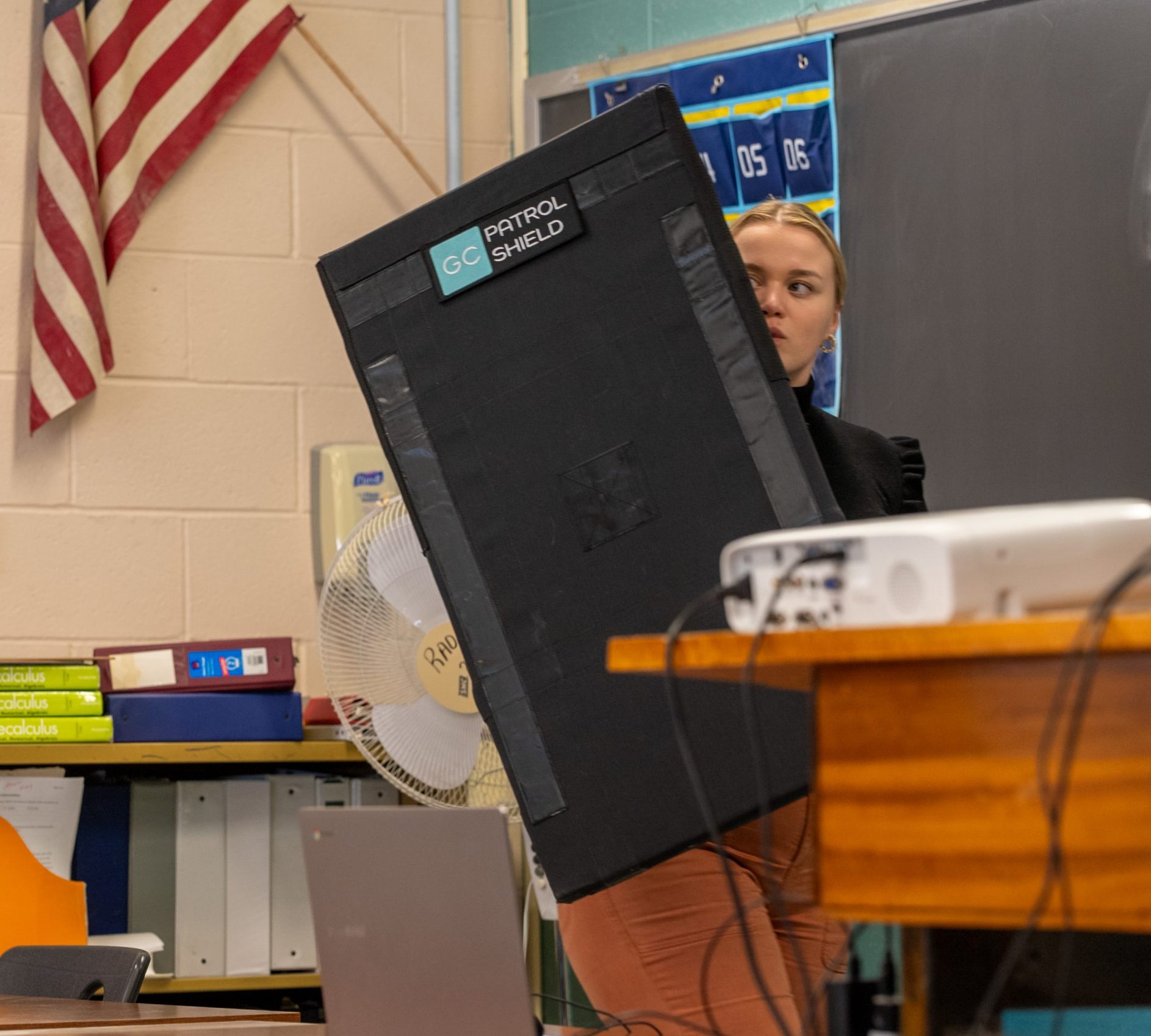
A shield that’s too heavy for daily carry doesn’t get carried daily. GC Compact Shield is 10 lb, half the size of GC Patrol Shield, and rifle rated, sized specifically for vehicle-based SRO carry and small enough to fit on the passenger seat of a cruiser for immediate access.

For more detail on full placement breakdown, including vehicle-based, building-based, multi-building, and shared-facility configurations, read more at ballistic shield placement in schools.

What to know: Weight and size determine whether a shield is carried and reached in time. GC Compact Shield at 10 lb is built for that constraint.

3. Criterion 2: Independent verification, not just an NIJ rating

An NIJ rating confirms the ballistic material stopped a round under controlled conditions. It doesn’t confirm how the complete shield performs as a system, under environmental conditioning with multi-shot impacts, or edge and angled hits. ASTM E3347-25 verification tests that complete system. GC Patrol Shield and GC Compact Shield are ASTM E3347-25 verified at both RF1 (rifle) and SG (shotgun). They are the only shields verified at both ratings.

How verification fits into a defensible procurement record is covered in school security planning and duty of care.

What to know: An NIJ rating and an independent ASTM E3347-25 verification are two different, complementary facts. Ask for both, not just the rating.

4. Criterion 3: Warranty and total lifecycle cost

Warranty length is a total-cost-of-ownership lever, not a spec-sheet footnote. GC Patrol Shield carries a 10-year warranty, double the industry standard. That means fewer replacement cycles across a school’s typical 10–20 year capital planning horizon.

ballistic shield warranty for schools walks through the lifecycle-cost and the vendor questions to ask about warranty terms.

What to know: A longer warranty reduces the number of replacement cycles a district has to budget for over the same planning period. Get the warranty term in writing, alongside the testing record behind it.

5. Criterion 4: Storage and deployment speed under Run-Hide-Fight protocols

A shield stored where a trained user can’t reach it in seconds is not protection. It’s inventory. Placement should follow the threat assessment and align with the documented response plan rather than available storage space.

The full placement framework, covering accessibility, alignment, redundancy, and discretion by deployment setting, is at ballistic shield placement in schools.

What to know: Storage and deployment speed follows from the same threat assessment that drives the rest of the school’s response plan.

6. How to use this in practice

For school administrators:

  • Use all four criteria together in the procurement record (weight/accessibility, verification, warranty, and deployment speed) rather than evaluating any one in isolation.
  • Document why each criterion was met, not just the upfront price, to support a defensible procurement decision.

For safety personnel and SROs:

  • Weigh GC Compact Shield against GC Patrol Shield using the deployment context (vehicle-based carry vs. building-based staging) as the deciding factor, not weight alone.
  • Confirm placement and training are reviewed together. A shield that’s accessible on paper but untrained-for isn’t accessible in practice.

Questions to ask a vendor, mapped to the four criteria:

  • Weight/accessibility: What is the shield’s weight and size, and has it been evaluated for the specific deployment context (vehicle-based, building-based, or both)?
  • Verification: Is the shield independently verified beyond its NIJ rating, and by which lab?
  • Warranty: What is the warranty term in writing, and what testing record backs it?
  • Deployment speed: What placement guidance does the vendor provide, and does it account for a school’s layout?

GC Patrol Shield: What the Answers Look Like


Criterion GC Patrol Shield GC Compact Shield
Weight / accessibility 20 lb (half the weight of comparable rifle-rated shields); suited to building-based staging 10 lb (half the size of GC Patrol Shield); fits a cruiser passenger seat for vehicle-based SRO carry
Independent verification ASTM E3347-25 verified at both RF1 (rifle) + SG (shotgun) ASTM E3347-25 verified (smallest shield on the market to pass)
NIJ rating Level III+ rated Level III+ rated
Warranty / lifecycle 10-year warranty 10-year warranty
Lab Independent ISO/IEC 17025 lab also qualified by NIJ; SEI-verified Same independent lab and SEI verification
Material Graphene composite construction Graphene composite construction
Product status Same commercial product sold since early 2024, no modifications for testing Same commercial product sold since early 2024, no modifications for testing

Neither product is the “better” answer in isolation. The right choice depends on which deployment model (vehicle-based or building-based) matches the school’s placement decision. GC Shield for schools covers the full product range and school-specific deployment options.

Key Takeaways

  • Four criteria decide whether a ballistic shield fits a school: weight/accessibility, independent verification, warranty/lifecycle cost, and storage/deployment speed.
  • GC Compact Shield (10 lb) and GC Patrol Shield (20 lb) answer these requirements differently depending on deployment context: vehicle-based SRO carry versus building-based staging.
  • Independent ASTM E3347-25 verification is a separate, complementary fact to an NIJ rating. Both belong in a defensible procurement record.
  • A 10-year warranty reduces replacement cycles across a school’s typical 10–20 year planning horizon.
  • Storage and deployment speed should follow the threat assessment and documented response plan, not available storage space.

GC Patrol Shield is NIJ Level III+ rated and ASTM E3347-25 verified, the most complete testing record available for a ballistic shield. Speak to the GC team or download the brochure to find out more.