
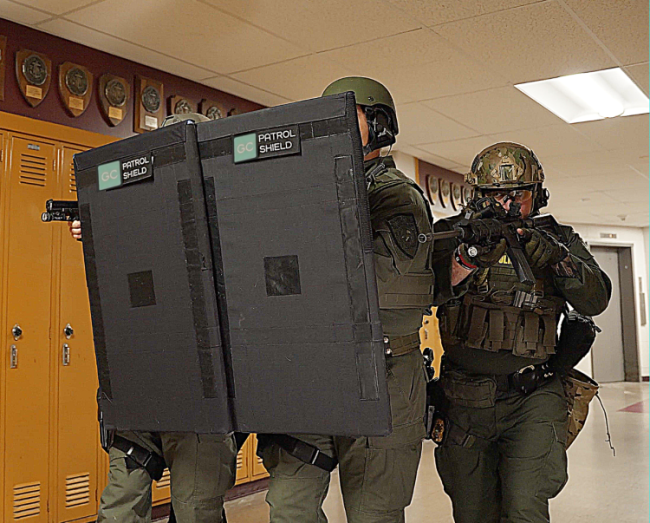
Edge Shot Protection
Next gen GC Patrol Shield verified to stop 1-inch edge shots
GC Patrol Shield’s next gen shield has been verified to stop 1 inch edge shots for RF1 and Shotgun threats in ASTM E3347 tests this summer.
That performance far exceeds the 2-inch shot-to-edge distance required by both NIJ and ASTM, which consider 1-inch edge shots as unfair hits. Even more significant is the fact that GC Patrol Shield’s 1-inch shot-to-edge performance was achieved under the full ASTM conditioning process, including temperature shock, water immersion, and final high/low temperature preparation. The testing was conducted by an independent, ISO-qualified NIJ laboratory and verified by Safety Equipment Institute.
Here is why it matters:
The zone both NIJ and ASTM exclude
Previously we examined the edge shot gap in NIJ testing. ASTM closed that gap by mandating edge shots be included just beyond the two-inch perimeter. A significant step forward, but still not within the 2-inch shot-to-edge area. Inside those two inches, neither standard requires the shield to stop a round.
That is not a flaw in either standard and ASTM set a meaningful and achievable approach that raised the bar across the industry by requiring shots near that 2-inch perimeter. The 2-inch minimum reflects sound judgment where reliable, repeatable testing can be conducted.
Operationally, this is significant—the boundary is still there. As one patrol captain observed, the 2-inch perimeter “around the whole thing” effectively makes a conventional shield about 30% smaller. An officer cannot count on protection in this zone. The shield’s protective area is much smaller than its physical dimensions, even though the operator is carrying that extra weight.
At 1 inch shot-to-edge distance, the shield’s area of protection is far greater and that’s why GC Patrol Shield’s result matters.
Why the last inch matters most
The perimeter is where engineering is hardest and where failure is most dangerous. Close to the edge, the material has less area to distribute impact energy. The backing structure transitions and the physics works against the shield in the zone both standards exclude.
Ron Tetreau, a 30-plus-year law enforcement and military veteran and former SWAT team leader, put it directly after live edge shot testing: “If you did this with a conventional shield, you would see perforations, which could severely injure the shield operator, not to mention spalling or bullet ricochet, which could severely injure anyone near the shield.”
Spalling and fragmentation risks are highest at the perimeter. Pushing verified performance from 2 inches to 1 inch improves the zone where those secondary hazards are greatest.
How GC Shield achieved this
The patented materials design of GC’s shield line is what makes 1-inch edge performance possible. Where conventional shield materials lose ballistic integrity near the perimeter (constrained geometry, reduced energy distribution) our composite maintains performance closer to the edge, even under extreme environmental conditions.
What this means for purchasing decisions
When your department evaluates a ballistic shield, the NIJ rating tells you the central strike face can stop a specified round. ASTM extends that verification toward the perimeter. And GC Patrol Shield’s verified 1-inch edge shot protection goes further still. To date only two shield manufacturers have managed to pass the ASTM standard for RF1 and none for Shotgun.
The question you should be asking is straightforward. At what distance from the edge can your shield maintain officer safety? The answer tells you how much of the shield’s face has been proven to stop rounds and how much you are taking on faith.
As one officer put it when describing GC Patrol Shield’s edge protection: “What you see is what you get.” And with the next gen GC Patrol Shield’s one-inch shot-to-edge verified protection, more of what you see has been tested than any ballistic shield standard has ever required.
More details on the next gen GC Patrol Shield will be coming soon.