
How Officers See Without a Viewport
Viewport Series Part 2: Situational Awareness
The question every viewport conversation starts with
If we are asked how can an officer see without a viewport, it’s a fair question. It assumes that seeing through the shield is the primary method of maintaining situational awareness. That assumption is worth examining, because the answer is simpler than the question suggests, and it’s been in law enforcement training longer than the viewport has been in shield design.
Looking around a shield is not a new skill
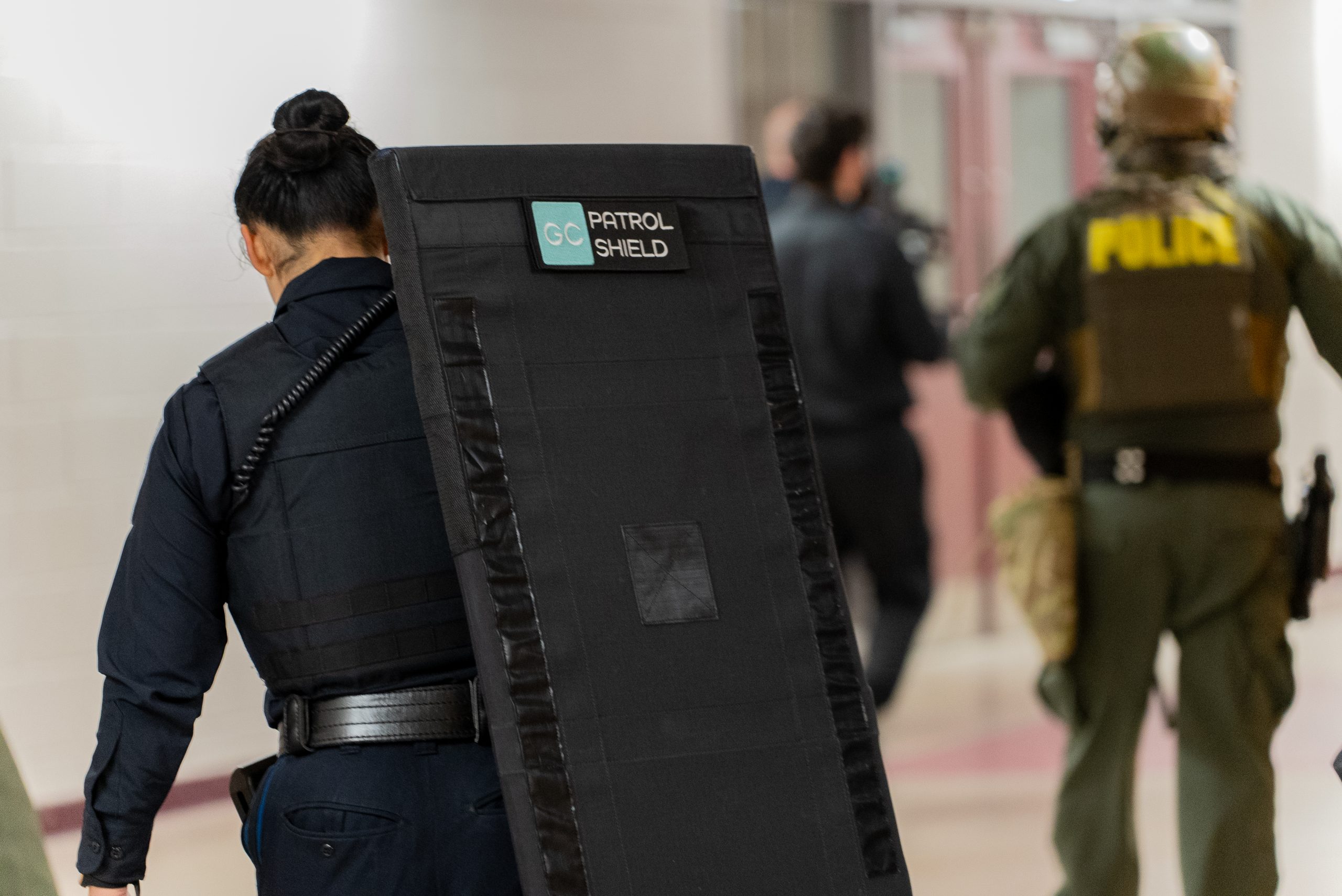
Consider what maintaining situational awareness without a viewport requires. The officer moves the shield slightly, angles their head and observes the space in front of them before advancing or repositioning. This is the same technique officers have been trained to use at every corner, doorframe and piece of cover in room-clearing exercises.
Law enforcement has always taught officers to use walls, doorframes, vehicles and other objects before advancing. The principle is to look before committing, and to use cover without exposing more than necessary. The shield is another object to look around. The technique is identical to what officers do with every other piece of cover they encounter.
This is not a workaround for the absence of a viewport. It is a foundational skill of movement in closed environments, and it is one every officer has been trained to do before they ever touch a ballistic shield. It requires no additional instruction, no new equipment, and no component built into the face of the shield.
Ron Tetreau, a 30-plus-year law enforcement and military veteran and former SWAT team leader, describes the operational reality directly: in the high-risk scenarios where shields are deployed, situational awareness depends on positioning and team communication. The shield provides ballistic cover. The officer provides awareness by using the environment the same way they always have.
The technique that works when the viewport fails
A viewport that is compromised removes the sight line the officer was using. The officer must now look around or over the shield to see ahead. The technique they needed when the component failed is exactly the technique that works without one.
An officer who has trained exclusively using a working viewport now faces a decision during an incident: the equipment they relied on is unavailable, and they need to fall back on a method they haven’t necessarily practiced with their shield. The technique is the same whether the shield is new or has been in service for years.
As Part 1 of this series noted, a viewport that is damaged cannot be field-repaired. The officer carries a compromised shield until it is replaced. The question for training planners is: has the officer also trained for operating without the viewport they just lost?
Body-worn and shield-mounted cameras
Technology provides additional options that are more versatile than a fixed viewport.
Body-worn cameras. Officers in most agencies already wear body cameras. A body-worn camera feed provides a continuous view of the environment without requiring the officer to position their face behind a panel at the weakest point of the shield.
Shield-mounted cameras. A camera mounted to the face of the shield provides a direct view of what’s in front of it, with greater flexibility than a fixed viewport allows. The camera can be placed where it provides the most useful field of view rather than where the viewport permits.
Neither option adds 8 lb to the shield. Neither constrains the visual field to a small, fixed window. Neither places the officer’s face at the glazing interface.
Team communication and tactical positioning
Officers rarely operate behind a shield alone. In an active shooter or barricaded subject scenario where ballistic shields are often deployed, situational awareness is a team function.
A flanking officer provides coverage of angles the shield carrier cannot see directly. A team member on communications relays information from the wider environment. Tactical positioning, moving toward cover before observing and using the space to minimize exposure, is the method law enforcement has used in high-risk entries long before body cameras were standard equipment.
An SRO based in MA put it plainly after taking delivery of GC Patrol Shield: “You have full ballistic coverage through the whole shield. We don’t have to worry about the port holes and things of that nature.” A chief with Weston PD described the same point: “GC Shield, what you see is what you get. That’s what’s going to protect you. It’s not that you have to kind of guess where the bullet’s going to go.”
Both officers arrived at the same conclusion independently. A shield that gives complete coverage is simpler to operate.
What this means for training
The choice between viewport and viewport-free design is partly a training choice. An agency that procures viewport shields trains officers to use the viewport as their primary means of forward awareness. When that component fails, the officer needs a fallback they may not have practiced.
An agency that trains viewport-free produces officers whose awareness technique is portable. It works with any shield, in any configuration, under any conditions, because it was never built around a single component. The method that works when nothing has gone wrong also works when something has.
The practical question in any training program is: what does the officer do when the viewport is unavailable? If the answer is look around the shield, then the question becomes why that is not already the primary technique, because it works just as well when the viewport is functioning, and it works better when it’s not.
Part 3 of this series examines what ballistic standards require of viewports, and what independent testing has revealed about the protection they provide.