Active Shooter Preparedness in Schools

When the call comes in, preparation is everything.

For SROs | School Security Staff | Safety Leads
TL;DR:

  • Preparedness is a system: threat assessment, response planning, training, and protective equipment working together
  • Run, Hide, Fight defines occupant behaviour. SRO and security staff roles go further
  • Protective equipment adds real capability only when staged, familiar, and integrated into training
  • No measure eliminates all risk. The goal is faster, better decisions under pressure

PREPAREDNESS IS A SYSTEM

When an active shooter incident occurs in a school, the people who matter most are already inside. There is no time to improvise a plan. The quality of the response depends entirely on what was decided, trained, and staged before the call came in.

That is why preparedness is the right word, not protection, and not prevention alone. Threat assessment, response planning, training, and protective equipment each plays a distinct role, and none works without the others.

1. Threat Assessment: Knowing Your Environment

Effective preparedness starts with an honest assessment of the facility and its vulnerabilities. Generic plans built around generic assumptions fail when they meet your building.

A thorough threat assessment covers:

  • Entry points and access control gaps
  • High-density areas where occupant concentration creates risk
  • Communication system coverage and dead zones
  • Sightlines and surveillance gaps
  • Historical incident data from the local area

The output is not a report. It is a prioritised list of vulnerabilities that drives where resources go, where equipment is staged, and which scenarios response plans need to address.

2. Response Planning: Run, Hide, Fight as a Framework, Not a Script

Run, Hide, Fight is the established framework for occupant response during an active shooter incident. For SROs and security staff, your role goes further. You are the resource that enables others to run, hide, or fight safely, and to intervene when the situation demands it.

That requires response plans that go beyond the three-word framework:

Lockdown Protocols

How rooms are secured, movement restricted, and occupants kept safe in place. Protocols define what to do until the threat is resolved or officers guide them out.

Evacuation Protocols

Routes, assembly points, and accountability and the critical judgement call of when to evacuate versus stay in lockdown. Not every scenario calls for the same response.

Communication Protocols

How information flows between staff, security, and external responders. Communication breakdown is one of the most consistent factors in poor outcomes.

First Responder Coordination

The handoff from school security to police response must be fast and clear. Pre-shared maps, agreed terminology, and joint exercises make that happen.

Plans that are documented but not practiced are not plans. They are intentions.

3. TRAINING: FAMILIARITY REDUCES HESITATION

Under acute stress, people revert to their training. If the training is shallow, the reversion is to instinct, and instinct alone is rarely enough in an active shooter scenario.

For SROs and security staff, that means going beyond drills: weapon familiarisation, shield deployment, communication under stress, and coordination with responding law enforcement. These skills require repetition, not a briefing.

4. Protective Equipment: Part of the System, Not a Substitute for It

Protective equipment adds real capability to a prepared response. It does not replace planning or training but when staged correctly, familiar to the user, and integrated into documented procedures, it changes what trained responders can do.

For SROs and school security staff, that means selecting equipment that fits the operational reality of a school environment, not just the ballistic standard.

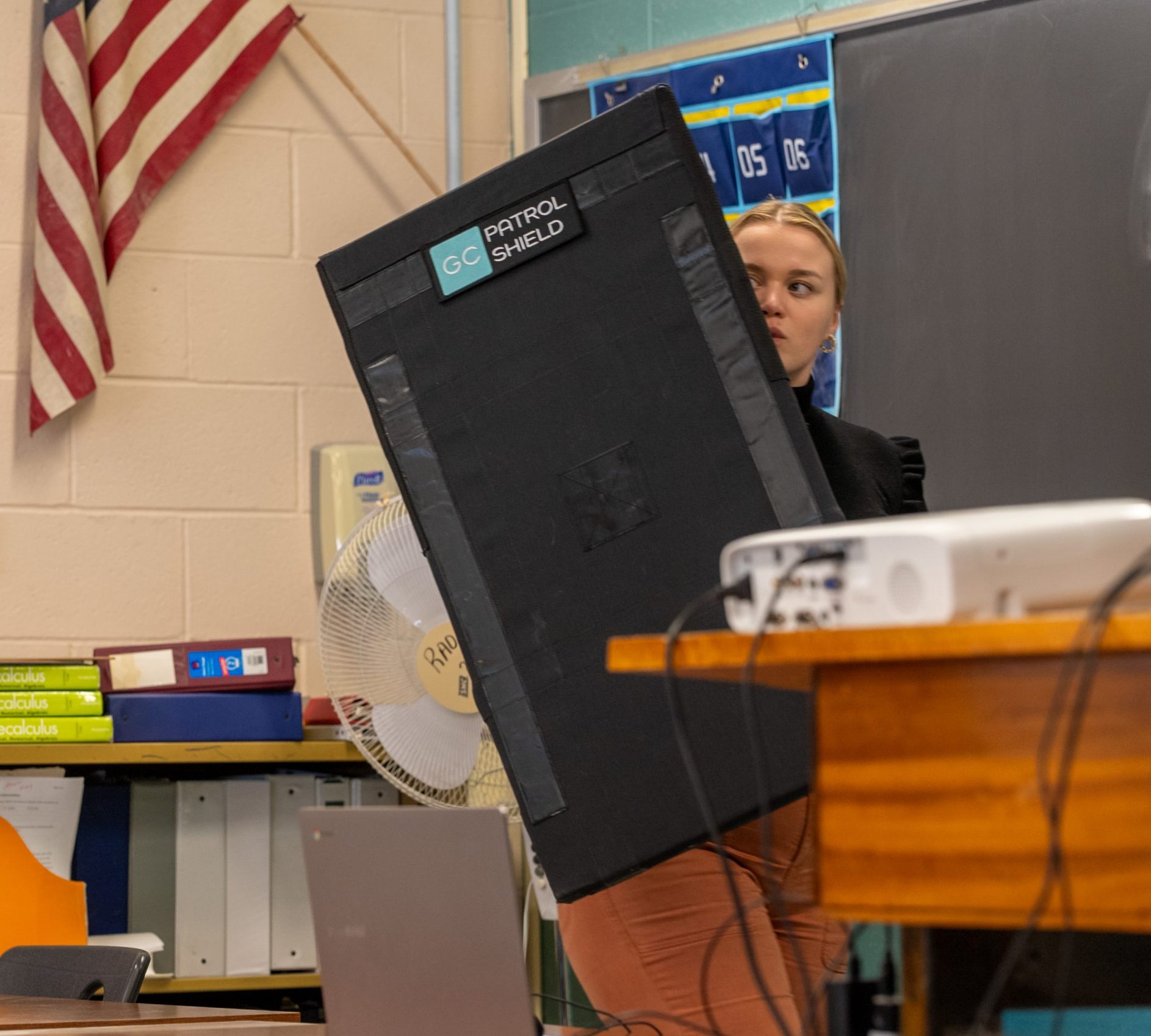
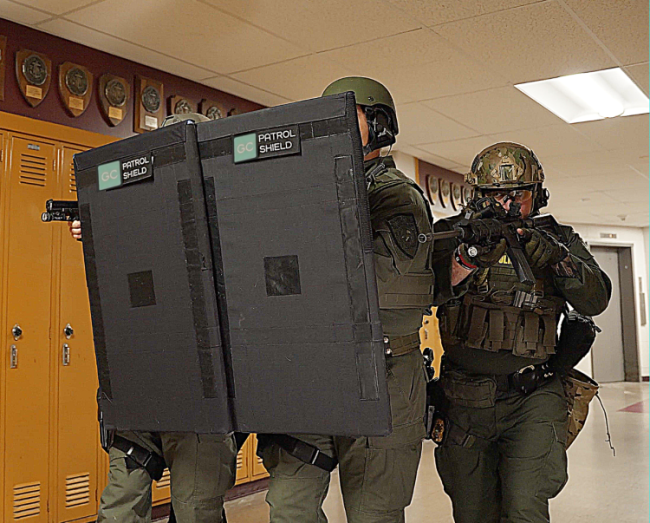
GC Patrol Shield is built for this environment:

  • NIJ Level III+ rated: rifle and shotgun protection
  • ASTM E3347-25 verified: the most demanding real-world ballistic shield standard currently available
  • 20 lb: half the weight of comparable rifle-rated shields
  • Deployable by any trained staff member regardless of physical conditioning
  • Shield wall capability for coordinated response scenarios
  • 10-year warranty: double the industry standard

During a lockdown, GC Patrol Shield gives an SRO advancing toward a threat frontal rifle protection while moving, something a vest cannot provide. During an evacuation, it provides cover for staff guiding students through exposed corridors. No viewport means no glazing-to-body interface, one less weak point in the shield’s structural profile.

Learn more about GC Patrol Shield for schools.

5. WHAT PREPAREDNESS DOES AND DOESN’T DO

Preparedness does:

  • Reduce the time it takes to make the right decisions under stress
  • Improve coordination between staff, security, and first responders
  • Provide additional protective options through staged equipment and trained personnel
  • Demonstrate institutional duty of care through documented planning and training
  • Improve outcomes for students and staff when an incident occurs

Preparedness doesn’t:

  • Prevent every incident or guarantee no harm occurs
  • Remove the need for human judgment in unpredictable scenarios
  • Replace the situational awareness of trained SROs and security staff
  • Substitute for coordination with responding law enforcement

Understanding both is not pessimism. It is the basis of honest, effective planning.

  1. Active shooter preparedness is a system: threat assessment, response planning, training, and protective equipment working together
  2. Run, Hide, Fight defines occupant behavior. SRO and security staff roles require additional planning and training beyond the framework
  3. Protective equipment adds capability when it is staged, familiar, and integrated into documented procedures
  4. Preparedness is an ongoing process: threat environments, facilities, and staff change, and plans must change with them


READY TO STRENGTHEN YOUR SCHOOL’S RESPONSE?

GC works with schools to understand how protective measures fit into their broader safety strategy. Speak to the team about how GC Patrol Shield supports your preparedness planning.

FAQs

  • What is active shooter preparedness in schools?

    Active shooter preparedness is a system of interconnected measures: threat assessment, response planning, training, and protective equipment, designed to improve outcomes when an incident occurs. It is not a single product or procedure. The goal is to reduce uncertainty and improve decision-making under conditions that are designed to prevent clear thinking.

  • What does Run, Hide, Fight mean for SROs and school security staff?

    Run, Hide, Fight is the established framework for occupant response during an active shooter incident. For SROs and security staff, the role is different, you are the resource that enables others to run, hide, or fight safely, and to intervene when the situation demands it. Your response planning needs to go significantly beyond the three-word framework.

  • What should a school threat assessment cover?

    A thorough threat assessment covers entry points and access control gaps, high-density areas where occupant concentration creates risk, communication system coverage and dead zones, sightlines and surveillance gaps, and historical incident data from the local area. The output should be a prioritised list of vulnerabilities that drives resource allocation and response planning.

  • What is the difference between lockdown and evacuation protocols?

    Lockdown protocols define how rooms are secured, movement restricted, and occupants kept safe in place until the threat is resolved. Evacuation protocols define routes, assembly points, and accountability procedures. The critical judgement call is knowing which response is appropriate for a given scenario, that decision requires real-time situational awareness and clear communication.

  • Where does protective equipment fit in a school safety plan?

    Protective equipment is one layer in a broader safety system. It adds real capability when it is staged correctly, familiar to the user, and integrated into documented procedures. It does not replace planning or training, and should be selected based on the operational reality of the school environment, not just the ballistic standard.

  • What ballistic shield is best for school resource officers?

    GC Patrol Shield is NIJ Level III+ rated and ASTM E3347-25 verified, the most demanding real-world ballistic shield standard currently available. At 20 lb, it is half the weight of comparable rifle-rated shields, light enough for daily carry and rapid deployment by any trained staff member. Learn more about GC Patrol Shield for schools.
See more