
The round that arrives at an angle
ASTM E3347-25 Series — Part 5: Angled Shot Testing
The assumption built into standard testing
Every NIJ ballistic shield test is fired at the same angle: face-on, zero degrees, straight at the panel, from a fixed position. That test condition is reproducible, comparable across manufacturers, and straightforward to administer, but does not replicate a real-world scenario. A shield can carry a full NIJ rating without a single off-axis round having been fired at the panel. In dramatic contrast, ASTM E3347-25 requires angled shots. That’s what we’re focusing on today.
How officers move with shields
Ron Tetreau has more than 30 years in law enforcement and military service, including time as a SWAT team leader. He described the physical reality of getting a shield from the vehicle to the point of need: “You could be four houses down or five houses around a corner, even on a patrol basis. You have to get the shield there.” Moreover, making entry means still more moving, typically in more complicated patterns, such as advancing down hallways, rotating the shield to clear a doorframe, pivoting to cover a side door, or clearing a corner with the shield constantly repositioning as the team moves.
When a round is fired at the shield, the angle of impact on the strike face will depend on the shield’s orientation, which is likely not to be face on.
In other words, NIJ testing, conducted at zero degrees from a fixed position, rates the material under the one condition, which is the least likely to be sustained in the field.
What changes when the angle changes
A round striking a composite panel at an angle is a different physical event from one striking straight on. The mechanics are genuinely distinct.
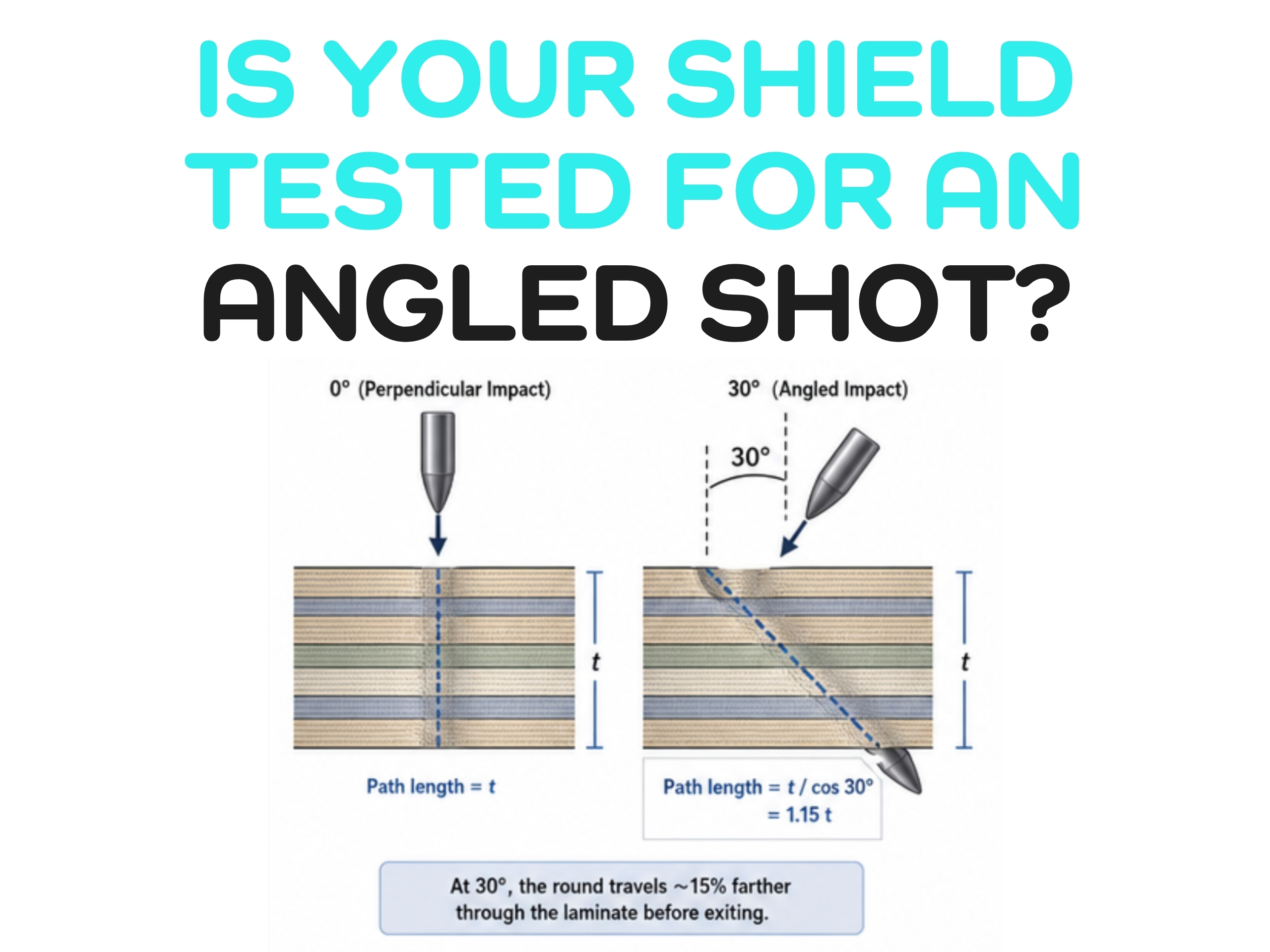
At zero degrees, the round drives straight through the material. The composite layers respond by stretching and absorbing energy across as wide an area as possible, the process described in Part 4 of this series. The outcome is predictable. The material has been engineered and tested to handle exactly this.
At an impact angle of 30 degrees, the round travels through a greater thickness of material before it can exit the other side. That sounds like an advantage for the shield, and sometimes it is. But the stress through the composite layers changes significantly. Research into angled impacts on composite laminates has established that the dominant failure mechanisms shift with angle. At lower angles, the primary failure mode is shear plugging: the round forces a plug of material through the panel. As the angle increases toward 30 degrees, shear plugging gives way to a combination of lateral compression, friction between the round and the material surface, matrix cracking, and delamination between layers.
Research shows angled impacts generate rear tensile and interfacial failure patterns that differ measurably from straight-on strikes, with failure becoming more pronounced as the impact angle increases.The layers most effective at stopping a straight-on round are not necessarily the layers carrying the most load when the round arrives at 30 degrees.
A panel optimised for face-on impact and tested only at zero degrees has not demonstrated performance under all the conditions that field deployment produces. That gap is what ASTM E3347-25 closes.
What ASTM E3347-25 requires
The angled testing requirements in ASTM E3347-25 are built into the main body test sequence. For every area of unique material construction, the standard requires two clusters at zero degrees and two clusters at 30 degrees. Each cluster consists of three rounds landing within a 4-inch diameter circle, as covered in Part 2 of this series. The 30-degree clusters require all three rounds to travel in the same direction, ensuring the angled stress pattern is consistent across the cluster rather than averaging out across different load paths.
The shield being tested at 30 degrees is not a fresh sample. It has already been through thermal shock cycling, water immersion, and an extended temperature hold, as covered in Part 1 of this series.
For shields with viewports, the viewport interface must be tested with a zero degree and a 45 degree shot (the viewport interface is the junction between the shield body and the glazing material along the viewport edge). For shields with multiple panels, joints between panels must be tested at angles between zero and 45 degrees, with the angle chosen to exploit any perceived weakness. The standard requires the laboratory to actively seek out the worst-case angle for each joint, not simply pick a convenient one.
The fastener shank shot, covered in Part 4, is also fired at 45 degrees, angled through the shield body toward the fastener shank. Angled testing in ASTM E3347-25 is not confined to the body panel.
How GC Patrol Shield performs
GC Patrol Shield passed ASTM E3347-25 angled shot testing in November 2025, covering both RF1 (rifle) and SG (shotgun) protection levels across all required threat types: 7.62x51mm M80 Ball NATO, 7.62x39mm MSC Type 56, 5.56mm M193, and 12 gauge 1oz slug. Testing was conducted by an independent, ISO-qualified third-party laboratory that is also one of four NIJ certified labs in the nation. The test results were verified by the Safety Equipment Institute (SEI) and will do so on an ongoing basis. The same commercial product sold since early 2024 passed without modification.
The test data covers both shield sizes. The GC Compact Shield – GC Shield’s smaller format option and the smallest ASTM E3347-25 verified rifle-rated shield on the market – was tested alongside the full-size GC Patrol Shield. Both passed angled cluster testing across all required threats on hot and cold conditioned test items.
What this means for procurement decisions
An NIJ rating confirms the panel material performs under straight-on, controlled conditions. It does not provide verified performance data for angled shots, the most likely round to strike a shield in the field. The officer reviewing an ASTM-verified shield has performance data for the conditions that occur in field deployment. The one reviewing a NIJ-rated shield does not.
If you haven’t read the earlier parts of this series, Part 2 covers multi-shot testing, Part 3 covers edge shot testing, and Part 4 covers weak point testing, including the requirement that a shield handle must remain functional after every impact, a pass/fail criterion NIJ has never included.
Part 6 brings together all five ASTM testing areas, and asks what the small number of shields that have passed ASTM E3347-25 tells us about the standard of protection officers are being given.
Sources
- ASTM E3347/E3347M-25 Standard Specification for Ballistic-Resistant Shields Used by Law Enforcement Officers https://store.astm.org/e3347_e3347m-25.html
- ASTM E3141/E3141M-24 Standard Test Method for Ballistic Resistant Shields for Law Enforcement https://www.astm.org/e3141_e3141m-24.html
- ASTM International — Increasing Confidence in the Performance of Ballistic Shields https://www.astm.org/news/ballistic-shields-tactical-safety-standards
- Police1 — Raising the bar: GC Patrol Shield becomes first rifle shield to pass new real-world ballistic standard https://www.police1.com/police-products/tactical/ballistic-shields/raising-the-bar-gc-patrol-shield-becomes-first-rifle-shield-to-pass-new-real-world-ballistic-standard
- Police1 — Ballistic shields must match escalating firepower https://www.police1.com/police-products/tactical/ballistic-shields/ballistic-shields-must-match-escalating-firepower
- Police1 — Why ballistic shield standards are getting a closer look https://www.police1.com/police-products/tactical/ballistic-shields/why-ballistic-shield-standards-are-getting-a-closer-look
- ScienceDirect — Effect of oblique impact on the failure modes and energy absorption of UHMWPE composite laminates https://www.sciencedirect.com/science/article/abs/pii/S0263822321010989
- University of Manchester — Investigation of failure modes and influence on ballistic performance https://research.manchester.ac.uk/en/publications/investigation-of-failure-modes-and-influence-on-ballistic-perform