
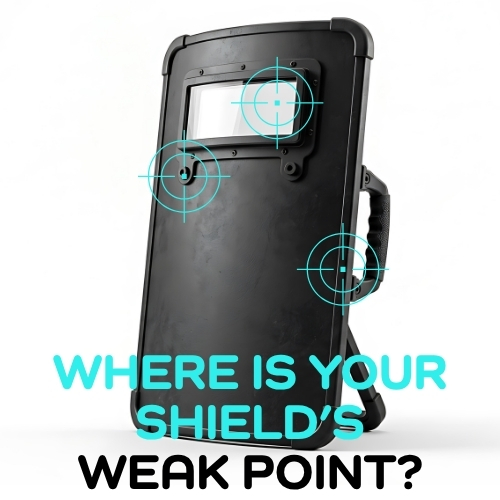
Weak Point Testing: Your shield stopped the round. But can you still hold it?
ASTM E3347-25 Series — Part 4: Weak Point Testing
What standard testing assumes about a shield
Under ASTM E3347-25, a ballistic shield can stop every test round (no penetrations, no panel failures) and still fail. For example, if the handle isn’t fully functional after the impacts, the shield hasn’t passed. That is a hard pass/fail requirement, not a note in the report.
NIJ testing has no equivalent requirement, since it concerns ballistic resistant protective materials (excepting body armor and helmets). Under NIJ 0108.01, passing means the rounds did not get through the ballistic resistant material. There is no consideration for whether the material is still operational – such concerns fall outside the scope of the test.
That difference points to what the two standards are measuring. NIJ was designed to evaluate ballistic materials, and so it tests them where they perform best: shots on the central strike face, spaced away from edges, away from hardware, away from any structural transition. The NIJ rating confirms one thing: the panel material, under controlled conditions, stopped the round.
ASTM E3347-25 asks whether the complete ballistic shield holds together as a usable system when subjected to test rounds. Weak point testing is where that question gets answered.
Why weak points matter
Every shield has structural transitions: whether these are areas where different materials meet, hardware passes through the ballistic panel, edges are finished and bonded, handles are mounted, etc.. These are the points at which the uniform protective properties of the ballistic material change and where a threat could perforate.
ASTM E3141-24, the test method underpinning E3347-25, identifies the categories that require testing: anywhere the material has been cut, bent, or joined; anywhere hardware passes through the panel; anywhere two different materials meet at an edge or seam; and anywhere separate panels connect in a multi-panel shield. These are the points at which shields are most likely to behave differently under ballistic impact than the central strike face – and NIJ standard testing has never required any of these points be challenged.
In other words, a shield could carry an NIJ 0108.01 rating without a single round having been fired near a handle mount, attachment hardware, edge transition, or material joint.
The material science behind structural transitions
Ballistic panels stop rounds by absorbing and distributing the energy of impact, though the mechanism varies depending on the material. Steel deflects and deforms. Ceramic shatters to dissipate energy. In composite materials like those used in GC Patrol Shield, the force radiates outward through the layers like a ripple across water: the fibres in those layers stretch to absorb energy.. The layers themselves partially separate under the force, creating more surface area that absorbs more energy in turn. The more area of the panel involved, the more effectively it works. That process depends on the material being continuous, which is why structural interruptions like hardware attachment points change the equation.
That process depends on the material being continuous. A hole breaks the continuity. When a bolt or anchor passes through the ballistic panel to attach a handle, it creates an interruption in the material. When an impact occurs near that point, the energy that would otherwise radiate outward hits the boundary of the hole and concentrates there. Research into composite laminates under ballistic conditions confirms that strength, impact resistance, and energy absorption are all measurably reduced in material near holes and interruptions compared to the same material in an uninterrupted zone.
The handle mount bolts on most ballistic shields pass through the protective material to attach to the shield body. That attachment point is a hole in the panel. The material immediately around it behaves differently under impact than the material at the centre and that difference has, under NIJ, never been required to be tested or demonstrated.
What ASTM E3347-25 requires
ASTM E3347-25 closes this gap with a systematic approach. Before testing begins, the shield manufacturer must provide a build sheet and dimensioned diagram identifying the location of all hardware, potential weak points, and viewport-to-body interfaces. The tester works from that document. Nothing is left to assumption.
The standard requires three distinct shot types for fasteners (the bolts, screws, rivets), anchors that attach handles and hardware to the shield body, each targeting a different failure mode.
A fastener head shot is fired at 0° directly at the fastener head, testing whether the hardware and surrounding material hold under direct impact. A fastener proximity shot is placed within 20mm of the fastener shank, targeting the ballistic material as close to the attachment point as possible without hitting the fastener directly. A fastener shank shot is fired at 45°, angled through the shield body toward the fastener shank, the most demanding of the three, designed to test the interface between hardware and material at an oblique angle.
For broader weak points, shots are placed at or near each identified location, with placement specified to within 6mm. The standard states that weak point shots shall be taken regardless of any obstruction. If a light, camera mount, or any other device sits in front of a weak point, the shot is taken through it.
One requirement stands apart. After every shot on a shield test item, the handle must remain functional. The shield must be repositionable back to its intended use configuration in the test mounting system. This is a pass/fail criterion. A shield that cannot be held and used after absorbing ballistic impacts has failed, regardless of whether the round penetrated the panel.
All of this takes place on a shield that has already been through the full environmental conditioning sequence covered in Part 1 of this series: thermal shock cycling between extreme heat and cold, water immersion, and a further extended temperature hold before ballistic testing begins. The shield arriving at weak point testing has not come fresh from the factory. It has already been through the stresses of real-world storage and deployment.
How GC Patrol Shield performs
GC Patrol Shield passed ASTM E3347-25, including weak point testing, in November 2025. The verification covers both RF1 (rifle) and SG (shotgun) protection levels. Testing was conducted by an independent, ISO-qualified third-party laboratory also qualified by NIJ, with results verified by the Safety Equipment Institute (SEI). Throughout testing, the shield was suspended by its handles in the ASTM-specified mounting system and those handles remained fully functional after every shot.
GC Patrol Shield has no transparent viewport. Under ASTM E3347-25, shields with viewports require a separate category of testing: shots at the viewport centre, corners, and edges, as well as dedicated interface shots where the glazing material meets the shield body. Each represents a distinct structural transition that must be tested and passed individually. GC Patrol Shield has no viewport, allowing a uniform structural profile across the full shield face, with no glazing-to-body interface to account for. Situational awareness is maintained through body-worn and shield-mounted cameras or tactical positioning, allowing officers to observe and respond without placing their line of sight behind a panel that introduces its own structural considerations. The result is a more r.
The verification was achieved with the same commercial product sold in the market since early 2024. No modifications were made for testing. The shields agencies are purchasing today are the same design and manufacture as those that passed.
What this means for procurement decisions
When procurement decisions rely solely on NIJ ratings, they are evaluating a material, not a usable shield. ASTM E3347-25 certification is the only current standard that confirms the complete shield holds together as a system an officer can use under fire.
A shield that stops a bullet but cannot be held is not protection. ASTM E3347-25 is the first standard to test for that directly. It is worth knowing whether yours has passed.
If you haven’t yet read the earlier parts of this series, Part 2 covers multi-shot testing – why three rounds landing close together on an already-stressed shield tells you something a single spaced shot never can. Part 3 covers edge shot testing – including how a shield can be perforated at the edge and still carry a full NIJ rating, because NIJ has never been required to test the perimeter.
Next month, Part 5 examines angled shot testing — why the angle of attack matters and why NIJ’s perpendicular-only testing leaves a gap that ASTM E3347-25 closes.
Sources
- ASTM E3347/E3347M-25 Standard Specification for Ballistic-Resistant Shields Used by Law Enforcement Officers — https://store.astm.org/e3347_e3347m-25.html
- ASTM E3141/E3141M-24 Standard Test Method for Ballistic Resistant Shields for Law Enforcement — https://www.astm.org/e3141_e3141m-24.html
- ASTM International — Increasing Confidence in the Performance of Ballistic Shields — https://www.astm.org/news/ballistic-shields-tactical-safety-standards
- Police1 — Raising the bar: GC Patrol Shield becomes first rifle shield to pass new real-world ballistic standard — https://www.police1.com/police-products/tactical/ballistic-shields/raising-the-bar-gc-patrol-shield-becomes-first-rifle-shield-to-pass-new-real-world-ballistic-standard
- Police1 — Ballistic shields must match escalating firepower — https://www.police1.com/police-products/tactical/ballistic-shields/ballistic-shields-must-match-escalating-firepower
- Police1 — Why ballistic shield standards are getting a closer look — https://www.police1.com/police-products/tactical/ballistic-shields/why-ballistic-shield-standards-are-getting-a-closer-look
- ScienceDirect — Synergistic energy absorption mechanisms in UHMWPE laminates subjected to sequential high-velocity impacts — https://www.sciencedirect.com/science/article/abs/pii/S0263823125011541
- PMC — Effect of Impact Position on Repaired Composite Laminates Subjected to Multi-Impacts — https://pmc.ncbi.nlm.nih.gov/articles/PMC9693312/