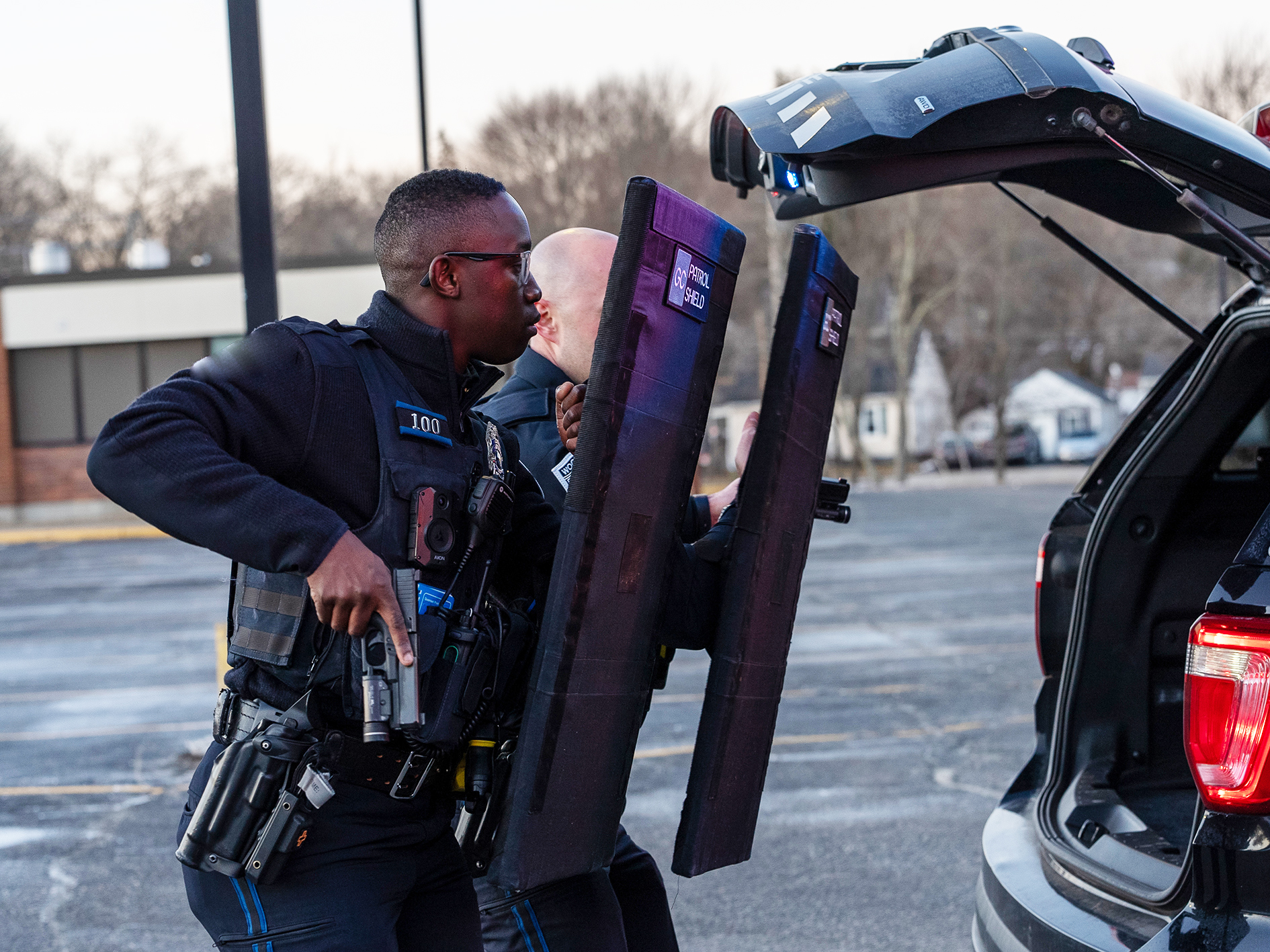
Rifle-Rated for Patrol: Why the Weight Argument Has Changed

The best ballistic shield for patrol officers is now rifle-rated. At 20 lb, it’s no longer only for tactical teams.

For Patrol Officers | Chiefs & Command Staff | Procurement Officers
TL;DR:
  • GC Patrol Shield is 20 lb half the weight of conventional rifle-rated shields and ASTM E3347-25 verified, making rifle-rated protection viable for daily patrol deployment, not just tactical call-outs.
  • GC Patrol Shield is NIJ Level III+ rated and verified at both RF1 (rifle) and SG (shotgun) threat levels under ASTM E3347-25, the most demanding ballistic shield standard currently available.
  • GC Compact Shield brings rifle-rated protection down to 10 lb, small enough for the passenger seat of a patrol cruiser, for agencies that need an even lighter daily-carry option.
  • Weight used to be the reason rifle-rated shields were reserved for tactical teams. That trade-off no longer holds with GC Patrol Shield.
  • An independent ASTM E3347-25 verification, not a weight figure alone, is what confirms a lighter rifle-rated shield still performs.

1. Rifle-rated protection has long been treated as a tactical-only weight class

For years, the standard advice for patrol-level ballistic protection has defaulted to handgun-rated (NIJ Level IIIA) shields, with rifle-rated protection reserved for tactical or SWAT deployment. The logic was straightforward: rifle-rated shields were heavy, and a shield an officer cannot carry or maneuver for an extended period is a liability, not a protection.

That logic was sound when it was set. It hasn’t kept pace with what rifle-rated shields now weigh.

What to know: A weight assumption that was accurate five years ago is not automatically accurate today. The relevant question for patrol deployment is not “is rifle-rated protection heavy” it’s “how much does this rifle-rated shield weigh, and is it verified to protect.”

2. The weight has changed

GC Patrol Shield weighs 20 lb, half the weight of conventional rifle-rated shields. That weight reduction is what moves rifle-rated protection from a tactical-only weight class into daily-patrol territory.

GC Patrol Shield is NIJ Level III+ rated, exceeding the standard rifle protection threshold, and constructed from graphene composite, a material that achieves rifle-rated performance at this weight without reducing the protection

For agencies needing an even lighter option, GC Compact Shield brings the same rifle-rated protection down to 10 lb. Small enough to sit on the passenger seat of a patrol cruiser. For more on how weight, coverage, and fatigue trade off against each other, see the ballistic shield weight page.

What to know: The weight objection to rifle-rated patrol deployment is a fact about specific shields, not about the rifle-rated category as a whole. At 20 lb (or 10 lb for GC Compact Shield), the weight figure that justified defaulting to handgun-rated protection no longer applies.

3. What changes operationally at this weight

Weight determines how long a shield can be held in position, how quickly it can be deployed, and how a patrol vehicle’s storage and seating accommodate it.

  • Carry duration. A lighter shield can be held in a ready position longer before fatigue affects positioning and accuracy of movement.
  • Deployment speed. A shield small enough for the passenger seat. GC Compact Shield’s specification, is accessible from the moment a vehicle door opens, not after a deliberate trip to the trunk.
  • Daily-carry feasibility. A 40 lb shield in the trunk gets used for planned tactical deployments. A 20 lb or 10 lb shield is light enough to be part of the standard patrol kit, available for whatever the call turns into.

What to know: Vehicle-based deployment speed is a direct function of weight and storage location. A rifle-rated shield light enough and small enough for the passenger seat changes what “immediately available” means for patrol response.

4. ASTM E3347-25: the proof behind the weight claim

A lighter shield is only a meaningful upgrade if it still performs under real deployment conditions. That’s what ASTM E3347-25 verifies.

GC Patrol Shield was the first rifle-rated shield to pass ASTM E3347-25 where it is tested under extreme temperature conditioning, water immersion, multi-shot cluster testing, edge shots, weak point testing, and angled shots, at both RF1 (rifle) and SG (shotgun) protection levels. Testing was conducted by an independent, ISO/IEC 17025-qualified laboratory also qualified by NIJ, with results subsequently verified by the Safety Equipment Institute (SEI).

GC Patrol Shield passed with the same commercial product sold to agencies since early 2024, no modifications were made for testing.

What to know: ASTM E3347-25 verification confirms that a shield at this weight still holds together under the conditions of a real engagement, not just under a material-level NIJ test.

5. Two weight classes, one verification standard

GC Patrol Shield and GC Compact Shield are both built on the same graphene composite construction and verified against the same ASTM E3347-25 standard, the difference between them is coverage area, not protection level.

  • GC Patrol Shield (20lb). Full coverage, half the weight of conventional rifle-rated shields, built for general patrol deployment and tactical team operations.
  • GC Compact Shield (10 lb). Half the coverage area of GC Patrol Shield, small enough for the passenger seat, built for agencies prioritising the lightest and smallest daily-carry option.

For a deeper look at how coverage, weight, and deployment context should be weighed against each other, see the daily use vs. occasional use page.

What to know: The choice between GC Patrol Shield and GC Compact Shield is a coverage-area decision, not a protection-level decision. Both carry the same NIJ Level III+ rating and the same ASTM E3347-25 verification.

6. What this means for patrol-level shield decisions

When weight is no longer the deciding factor, the patrol-versus-tactical shield distinction stops being about what an officer can physically carry and starts being about deployment context and budget.

For chiefs and command staff evaluating standards compliance across a fleet of patrol vehicles, the relevant comparison is no longer “rifle-rated is too heavy for patrol” it’s “which rifle-rated shield carries the independent verification record to support daily deployment.” The ballistic shield procurement page covers the total cost of ownership for making that comparison, including warranty and lifecycle.

What to ask: Has the shield under consideration been submitted for ASTM E3347-25 verification? A rifle-rated shield that hasn’t been verified at this standard has not demonstrated performance under real deployment conditions, regardless of its weight figure.

7. How to use this in practice

For patrol officers:

  • If weight has been the reason rifle-rated protection wasn’t standard patrol kit, 20 lb (or 10 lb) changes that calculation.
  • Passenger-seat storage means rifle-rated protection can be part of the immediate response, not a tactical-only deployment.

For chiefs and command staff:

  • Standardising on a rifle-rated shield for patrol is now a weight-feasible decision. The remaining evaluation criteria are verification record, warranty, and total cost of ownership.
  • Ask whether a prospective shield has been ASTM E3347-25 verified, and at which threat levels (RF1, SG, or both).

For procurement officers:

  • Compare verification records, not just weight figures, when evaluating rifle-rated options for patrol-wide deployment.
  • Factor warranty length into the total cost of ownership comparison, a longer warranty reflects manufacturer confidence in long-term performance.

GC Patrol Shield: What the Answers Look Like


Criterion GC Patrol Shield GC Compact Shield
Weight 20 lb half the weight of conventional rifle-rated shields 10 lb half the coverage area of GC Patrol Shield
Vehicle deployment Standard patrol vehicle storage Fits passenger seat
NIJ rating Level III+ rated Level III+ rated
ASTM verification E3347-25 verified for RF1 (rifle) + SG (shotgun) E3347-25 verified for RF1 (rifle) + SG (shotgun)
Lab Independent ISO/IEC 17025 lab also qualified by NIJ; SEI-verified Same independent lab and SEI verification
Material Graphene composite construction Graphene composite construction
Product status Same commercial product sold since early 2024, no modifications for testing Same commercial product sold since early 2024, no modifications for testing
Warranty 10 years double the industry standard 10 years double the industry standard

Key Takeaways

  • GC Patrol Shield, at 20 lb, is half the weight of conventional rifle-rated shields, closing the weight gap that justified defaulting to handgun-rated protection for patrol.
  • GC Patrol Shield is NIJ Level III+ rated and ASTM E3347-25 verified at both RF1 (rifle) and SG (shotgun) levels, by an independent ISO/IEC 17025 laboratory also qualified by NIJ and the Safety Equipment Institute (SEI).
  • GC Compact Shield extends the same rifle-rated, ASTM E3347-25–verified protection down to 10 lb, small enough for the passenger seat of a patrol cruiser.
  • The weight reduction doesn’t trade away protection level: both shields carry the same NIJ rating and the same independent verification standard.
  • For patrol-level shield decisions, the relevant question is no longer whether rifle-rated protection is too heavy, it’s whether the shield under consideration carries the verification record to support daily deployment.

GC Patrol Shield is NIJ Level III+ rated and ASTM E3347-25 verified, the most complete testing record available for a ballistic shield. Speak to the GC team or download the brochure to find out more.