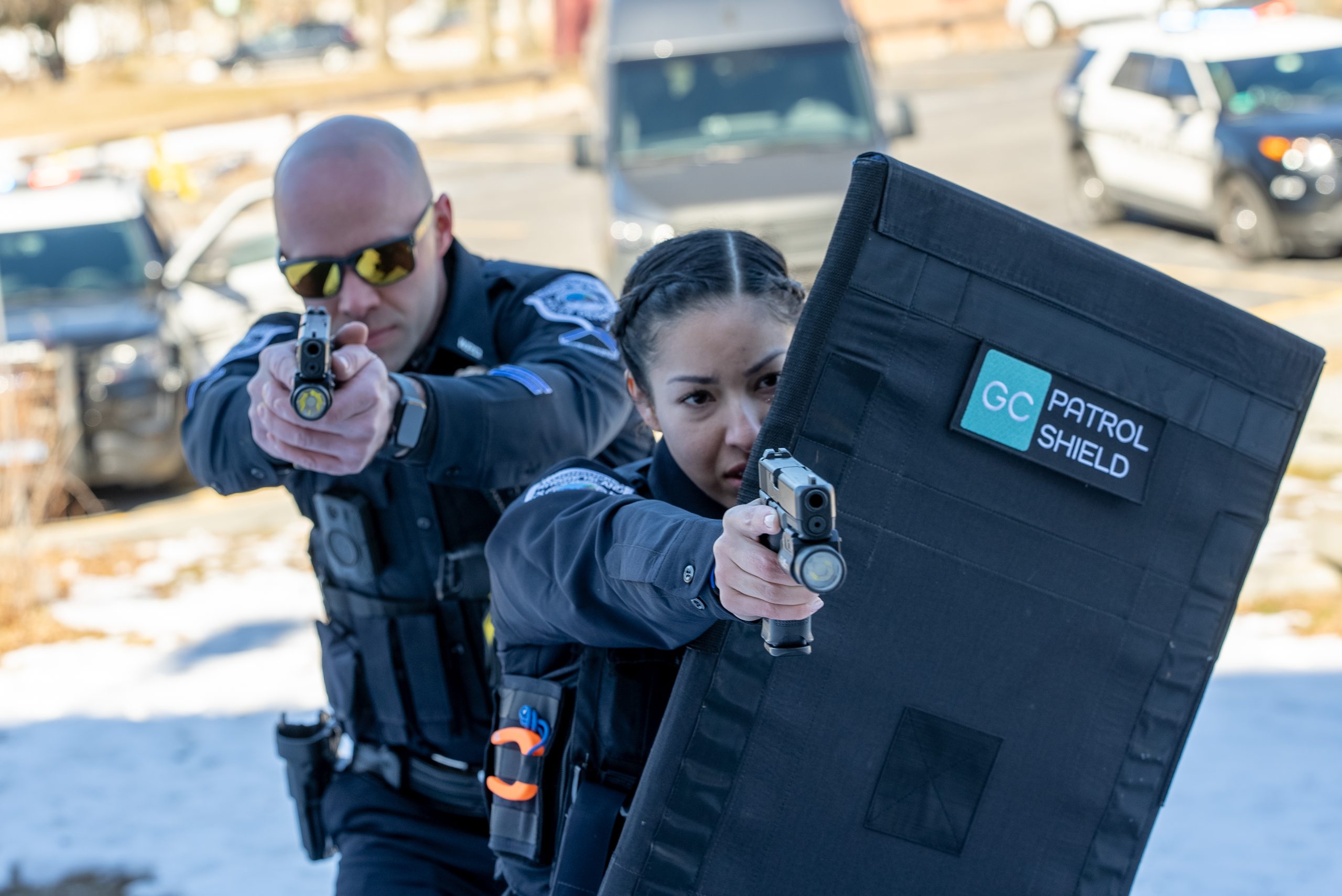
BALLISTIC SHIELD WEIGHT, COVERAGE AND FATIGUE: UNDERSTANDING THE TRADE-OFFS

The goal is not the lightest shield or the largest shield. It is the most usable combination for real operational conditions.

For Law Enforcement | Chiefs & Command Staff | Tactical Teams
TL;DR:
  • Weight, coverage, and fatigue are connected. Changing one affects the others
  • A heavier shield may offer more coverage on paper, but if it cannot be held consistently in the correct position over time, the effective protection it provides decreases
  • A lighter shield reduces fatigue and supports more effective sustained deployment, but only if the weight reduction does not compromise ballistic performance or coverage area
  • The goal is not the lightest shield or the largest shield. It is the most usable combination of weight, coverage, and protection that an officer can maintain effectively across real operational conditions
  • GC Patrol Shield achieves rifle-rated protection at 20 lb, half the weight of conventional rifle-rated shields, with ASTM E3347-25 verified coverage across the full shield including edges

1. Why Weight Is an Incomplete Metric

Weight is one of the first specifications procurement teams compare when evaluating ballistic shields. It is measurable, easy to compare, and directly linked to physical effort. That makes it a useful starting point but not a sufficient one.

Two shields with similar weights can feel and perform very differently depending on how that weight is distributed, how the shield is carried, the handle design and positioning, balance during movement and transitions, and how long the shield needs to be held in position.

A slightly heavier shield with better balance and ergonomics may be more effective in sustained use than a lighter one that is awkward to hold or poorly balanced. Weight is one input into the fatigue calculation, not the whole calculation.

2. How Coverage Affects Maneuverability

More coverage means more of the officer is protected. It also means a larger, heavier shield that creates more resistance during movement, may restrict visibility depending on design, makes transitions slower in confined spaces, and increases the effort required to reposition or adjust under stress.

In environments like corridors, stairwells, doorframes, and vehicles, the environments SROs and patrol officers regularly operate in, these limitations become operationally significant. A shield that covers more surface area but slows movement or limits effective positioning may reduce overall protection rather than increase it.

Coverage must be evaluated in context. Protection is not only about how much area is covered. It is about how usable that coverage is during real movement and how consistently the officer can maintain it.

3. The Relationship Between Fatigue and Effective Protection

Fatigue is an operational factor, not just a comfort one.

As fatigue increases during an extended engagement or carry, shield positioning becomes less precise, posture begins to degrade, reaction time may slow, decision-making becomes more conservative or delayed, and officers may lower or adjust the shield to relieve strain.

Each of these effects reduces effective protection not because the shield’s ballistic performance has changed, but because the officer can no longer maintain the position that makes that performance relevant.

A shield that offers 40 lb of rifle-rated protection but cannot be held consistently in the correct position over a 10-minute advance through a building may provide less effective protection than a 20 lb shield that can. The ballistic rating does not change. The effective protection does.

For more detail onĀ why rifle-rated shields can now be the right default for patrol read this blog

4. Why Very Light Shields Introduce Their Own Trade-Offs

Weight reduction is not inherently beneficial beyond a certain point. A shield optimised primarily for low weight may involve trade-offs in coverage area, structural characteristics, balance, or handling dynamics under stress.

A very light shield that is harder to control, more sensitive to movement, or less stable under sustained hold may not deliver the endurance benefit its weight suggests. If the design becomes less stable or more difficult to position effectively, officers may experience fatigue differently, not from weight, but from the effort of maintaining control of a less predictable shield.

The goal is not to find the lightest shield. It is to find the most usable balance of weight, control, coverage, and protection for the specific operational environment.

5. What to Test or Evaluate Before Deciding

Because weight, coverage, and fatigue interact in ways that are difficult to assess from a specification sheet, field evaluation is particularly important for this set of factors.

Extended carry over realistic time periods. How does the shield perform after 10 minutes of carry, not just in a 30-second demonstration?

Movement through confined or complex environments. How does the shield handle in corridors, stairwells, and through doorframes? How does it affect transition between positions?

Sustained hold in the correct position. How long can the shield be held in the intended use position before positioning begins to degrade?

Repeated drills. How does performance change across a full training session, not just the first few repetitions?

Team-based movement. How does the shield affect spacing, tempo, and coordination in team operations?

Short demonstrations and static handling tests rarely reveal how a shield performs under sustained use. The goal of field evaluation is to understand not just how the shield feels initially, but how it behaves after repeated use over time.

For a detailed look at how weight and fatigue interact across repeated use, read Ballistic Shield Weight, Coverage and Fatigue: Understanding the Trade-Offs.

For guidance on how usage frequency affects evaluation, read Ballistic Shield Daily Use vs Occasional Use: What Changes in Procurement.

For information on re-evaluating legacy equipment, read Ballistic Shield Re-Evaluation: Why Legacy Shields May No Longer Be Enough.

6. The Design Decisions That Affect This Balance

Material composition. Advanced composite materials, including graphene composites, can achieve rifle-rated ballistic performance at significantly lower weight than steel or ceramic designs. The material determines where on the weight/protection curve a shield sits.

No viewport. Transparent viewports add weight, introduce additional hardware, and require edge sealing and transition materials at the viewport-body interface. A shield without a viewport is lighter, has fewer structural transitions, and eliminates the viewport interface as a potential weak point.

Handle design. Handle positioning, grip design, and the distribution of weight through the handle during carry affect how fatigue accumulates. A well-designed handle reduces strain and improves control during movement and transitions.

Coverage area. A smaller shield at equivalent protection level reduces weight and improves maneuverability. GC Compact Shield, at 10 lb and half the size of GC Patrol Shield, works in vehicle-based deployment, fitting on the passenger seat of a cruiser and providing rifle-rated protection in a format optimised for rapid deployment.

7. What This Trade-Off Analysis Does (and Doesn't) Tell You

Evaluating weight, coverage, and fatigue does:

  • Identify shields that are likely to be used consistently versus avoided due to physical burden
  • Surface designs that achieve better protection through material engineering rather than additional mass
  • Help match the right shield format to the specific operational environment and deployment pattern
  • Support more realistic training by reducing the physical barrier to regular, high-repetition drills

Evaluating weight, coverage, and fatigue doesn’t:

  • Replace ballistic testing data, a lighter shield must still meet the required protection standard
  • Predict individual officer performance under stress
  • Account for all variables in dynamic, high-stress engagements
  • Substitute for the training and familiarity that determine how effectively any shield is used

GC Patrol Shield: Rifle-Rated Protection at 20 lb

GC Patrol Shield delivers NIJ Level III+ rated, ASTM E3347-25 verified rifle protection at 20 lb, half the weight of conventional rifle-rated shields. Its graphene composite construction achieves this without a transparent viewport, eliminating the viewport interface as a structural variable and keeping the full shield face as a uniform, uninterrupted strike surface.

ASTM E3347-25 verification confirms that coverage extends to the edges: edge shots are a required test, not an excluded unfair hit. The shield that passed testing is the same commercial product sold since early 2024, with no modifications.

For vehicle-based SROs and patrol officers, GC Compact Shield offers the same graphene composite construction at 10 lb, in a format designed to fit on the passenger seat of a cruiser and deploy immediately on reaching an incident.

Learn more about GC Patrol Shield.

Key Takeaways

  • Weight, coverage, and fatigue are connected variables. Improving one typically affects the others.
  • Fatigue is an operational factor, as it increases, effective protection decreases regardless of the shield’s ballistic rating, because positioning and control degrade.
  • A heavier shield with more nominal coverage may provide less effective protection than a lighter, more maneuverable shield that can be held consistently in position over time.
  • Field evaluation over realistic time periods, not short demonstrations, reveals how these trade-offs play out in practice.
  • Material engineering can reduce weight without reducing protection. Advanced composite materials achieve rifle-rated ballistic performance at significantly lower weight than steel or ceramic alternatives.
  • The goal is the most usable combination of weight, coverage, and protection for the specific operational environment and deployment pattern.

GC Patrol Shield is NIJ Level III+ rated and ASTM E3347-25 verified, the most complete testing record available for a ballistic shield. Speak to the GC team or download the brochure to find out more.