
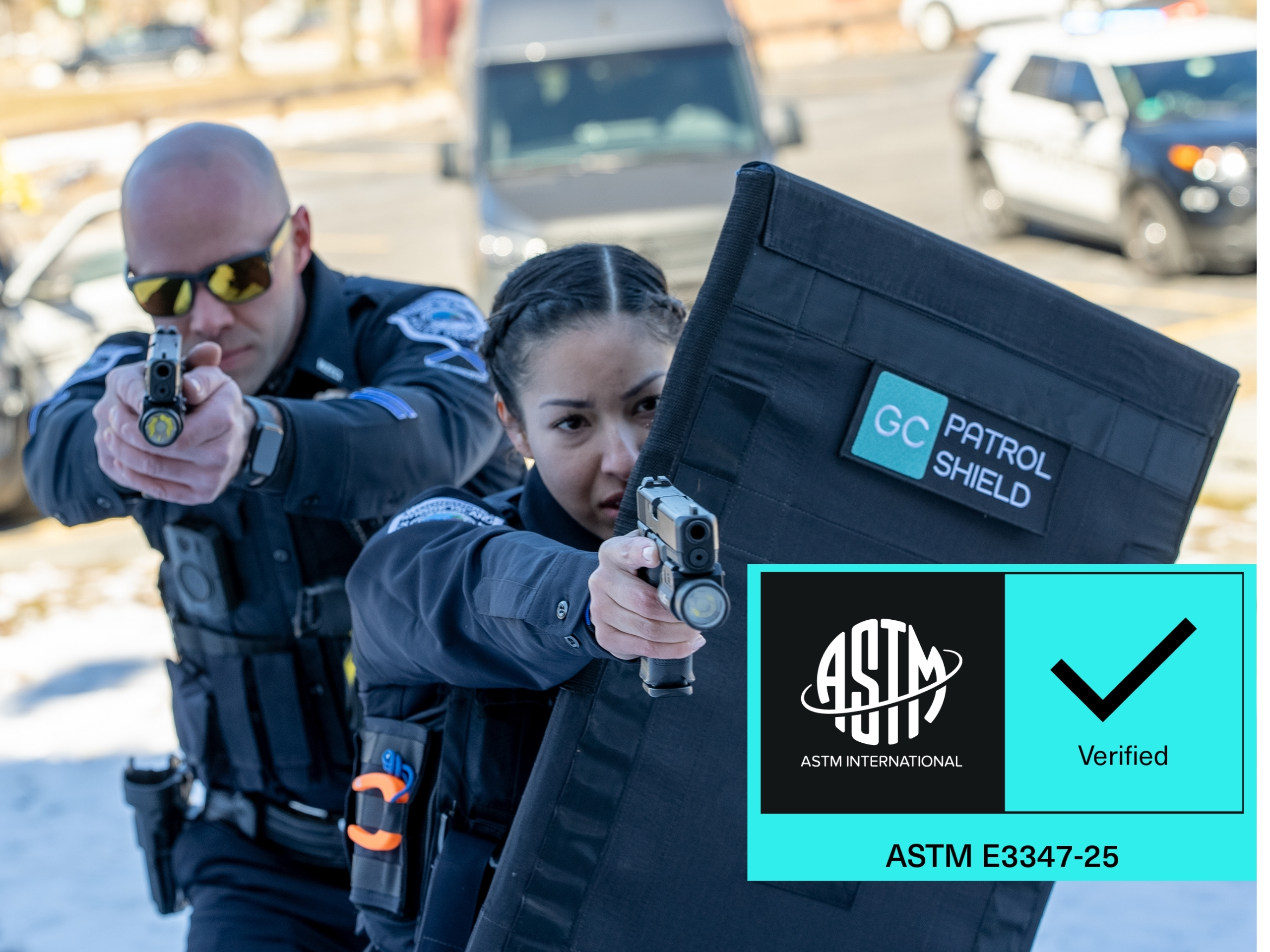
What Five Key Tests Reveal About the Shield on Your Officers’ Arms
ASTM E3347-25 Series Part 6: What the Standard Tells Us
The officer carrying the shield
Every ballistic shield in service represents a decision someone made on behalf of the officer carrying it. That decision was almost certainly made in good faith, against the best available information at the time, using the standard the industry has relied on for decades.
NIJ 0108.01 is that standard. It is rigorous within its scope, widely trusted, and the foundation on which procurement decisions across law enforcement have been built. Nothing in this series has argued otherwise.
But a standard is only as useful as the scenarios for which it tests. And NIJ 0108.01 was designed in 1985 to evaluate ballistic materials. It tests the central strike face at zero degrees, with shots spaced away from one another, edges, hardware, and any structural transition. It does not test what happens with an angled shot, cluster shots, strikes near handle mounts, hit a viewport, or edge-shots. Moreover, it does not require a shield to have been exposed to the temperature extremes of a patrol vehicle before ballistic testing begins.
Officers carry those shields into active shooter responses, barricaded incidents, and high-risk entries. They carry them down hallways, through doorframes, and into environments where neither the angle nor the target of incoming rounds is predictable. The question of whether a shield performs in those conditions is not academic. It is the only question that matters.
ASTM E3347-25 was built to answer this.
How officers move with shields
Ron Tetreau has more than 30 years in law enforcement and military service, including time as a SWAT team leader. He described the physical reality of getting a shield from the vehicle to the point of need: “You could be four houses down or five houses around a corner, even on a patrol basis. You have to get the shield there.” Moreover, making entry means still more moving, typically in more complicated patterns, such as advancing down hallways, rotating the shield to clear a doorframe, pivoting to cover a side door, or clearing a corner with the shield constantly repositioning as the team moves.
When a round is fired at the shield, the angle of impact on the strike face will depend on the shield’s orientation, which is likely not to be face on.
In other words, NIJ testing, conducted at zero degrees from a fixed position, rates the material under the one condition, which is the least likely to be sustained in the field.
What five tests reveal
Temperature and water immersion. Shields spend more time in patrol vehicles than they do in use. A vehicle interior in Phoenix in July regularly exceeds 140°F. The same shield stored in a Minnesota winter sits in temperatures well below zero. The materials in most high-performance shields respond to those extremes, but NIJ Standard testing does not. ASTM E3347-25 conditions shields through extreme heat, cold, and water immersion before a single round is fired. A shield that passes ASTM testing has demonstrated it performs in the conditions of real deployment, rather than having been shielded from them. Read More
Multi-shot impacts. NIJ testing spaces shots at least two inches apart across the strike face, but real engagements do not. ASTM E3347-25 requires multiple sets of three round clusters within a 4-inch circle, on a shield already conditioned through thermal conditioning. The question answered by ASTM is not whether a fresh panel can stop a single round, but rather whether the shield holds after concentrated fire, stressed by environmental conditioning. Read More
Perimeter coverage. Under NIJ 0108.01, a round striking within two inches of a shield’s edge is an unfair hit, and perforation there does not disqualify the shield. The perimeter, where materials engineering is the most challenging, does not require testing. Yet, an officer engaging with an armed subject cannot control where rounds land: The edges are always in play. ASTM E3347-25 mandates testing as near to that perimeter zone as possible. Read More
Structural integrity. NIJ places every shot on the central strike face, away from hardware and away from structural transitions. Handle mounts, viewports, attachment fasteners, edge bonding zones, and material joints are outside the scope of the standard entirely. ASTM E3347-25 requires the manufacturer to identify every structural transition before testing begins, then mandates shots at each of them. And it adds a requirement NIJ has never included: after every shot, the handles must remain fully functional. A shield that has stopped the round but can no longer be held, has failed. That is a pass/fail criterion. It is also the most significant operational requirement in the standard. Read More
Angled impacts. NIJ testing is conducted at zero degrees, straight at the centre of the panel from a fixed position. That describes almost no real deployment scenario. Officers make entry, they move through corridors and doorframes, the shield constantly repositioning as they advance. At the moment a round is fired, the angle of impact is whatever the shield’s current orientation happens to be. ASTM E3347-25 requires cluster shots at 30 degrees on any area of the shield strike face. The straight-on impact NIJ tests for is the exception. ASTM tests for the rule. Read More
What the number of verified shields tells you
ASTM E3347-25 has been available for over a year. In that time, only two manufacturers with rifle-rated shields have passed.
That is not because the standard is obscure. It has been covered in law enforcement media, discussed at industry level, and is increasingly referenced in procurement conversations and tenders. Manufacturers know it exists.
It is because passing is hard. The full test sequence is demanding by design, not to create a marketing differentiator for whoever clears it first, but because the scenarios it tests for are real and the gaps it closes are genuine. A shield that has not passed ASTM has not demonstrated its performance under environmental conditioning, concentrated multi-shot fire, perimeter impacts, structural weak point testing, or angled impacts. A shield that has passed only NIJ has demonstrated that its central panel, at room temperature, stopped five widely spaced rounds fired straight at it from a fixed position.
If the shield your officers are carrying has not been verified to ASTM E3347-25, it is worth asking why. If it has been submitted and not passed, it is worth asking what the test modalities were that it failed. And for any shield that ultimately passes ASTM E3347-25, it would be useful to know what had to change in order for it to do so. And what does that mean for all prior models of that shield which are fielded, but which do not pass the rigors of the standard. The standard exists. The testing is available. The results are on the record.
What GC Patrol Shield has demonstrated
GC Patrol Shield passed ASTM E3347-25 in November 2025, covering the full test sequence across all five areas covered in this series. The verification covers RF1 (rifle) and SG (shotgun) protection levels, making it the only shield verified at both levels under ASTM. Testing was conducted by an independent, ISO-qualified third-party laboratory also qualified by NIJ, with the ASTM results verified by the Safety Equipment Institute (an ASTM Affiliate)
The GC Patrol Shield model that passed is the same one that we have been selling to agencies since 2024. No modifications had to be made in order to pass ASTM testing. At 20 lb, GC Patrol Shield weighs far less than conventional rifle-rated shields. That matters not just as a specification but as an operational reality: a lighter shield allows an officer to hold their position longer, move more quickly, and move farther without becoming fatigued. Weight affects every one of the scenarios covered in this series.
There is also a 10-year warranty, double the industry standard. That is not a commercial detail. It is a statement of confidence in what the shield is made of and how it will hold up over years of real-world use.
The officers carrying GC Patrol Shield are carrying a shield that has been tested in the range of temperatures in which officers must operate, under the concentrated fire and perimeter impacts they must face, with handles that will remain functional, even when rounds arrive at unpredictable angles. That is what ASTM E3347-25 verification means in practice.
Has yours passed?
The five areas covered in this series are not edge cases. They are the conditions of real deployments. A shield rated only under NIJ has demonstrated its performance under optimal conditions, against the central strike face, at room temperature, at zero degrees.
Officers deserve equipment that has been tested for the real deal.
If you want to know more about GC Patrol Shield, or to discuss what ASTM E3347-25 verification means for your agency’s procurement decision, speak to the team.
Read the full series
- Part 1: Why Your Ballistic Shield Needs to Work in a Blizzard (And a Heat Wave)
- Part 2: Why Your Shield Needs to Survive Cluster Shots
- Part 3: The Shot NIJ Doesn’t Test: Edge Shot Testing
- Part 4: Your Shield Stopped the Round. But Can You Still Hold It?
- Part 5: The Round That Arrives at an Angle
Sources
- ASTM E3347/E3347M-25 Standard Specification for Ballistic-Resistant Shields Used by Law Enforcement Officers https://store.astm.org/e3347_e3347m-25.html
- ASTM E3141/E3141M-24 Standard Test Method for Ballistic Resistant Shields for Law Enforcement https://www.astm.org/e3141_e3141m-24.html
- ASTM International: Increasing Confidence in the Performance of Ballistic Shields https://www.astm.org/news/ballistic-shields-tactical-safety-standards
- Police1: Raising the bar: GC Patrol Shield becomes first rifle shield to pass new real-world ballistic standard https://www.police1.com/police-products/tactical/ballistic-shields/raising-the-bar-gc-patrol-shield-becomes-first-rifle-shield-to-pass-new-real-world-ballistic-standard
- Police1: Ballistic shields must match escalating firepower https://www.police1.com/police-products/tactical/ballistic-shields/ballistic-shields-must-match-escalating-firepower
- Police1: Why ballistic shield standards are getting a closer look https://www.police1.com/police-products/tactical/ballistic-shields/why-ballistic-shield-standards-are-getting-a-closer-look
- NIJ Standard: https://www.ojp.gov/pdffiles1/nij/099859.pdf