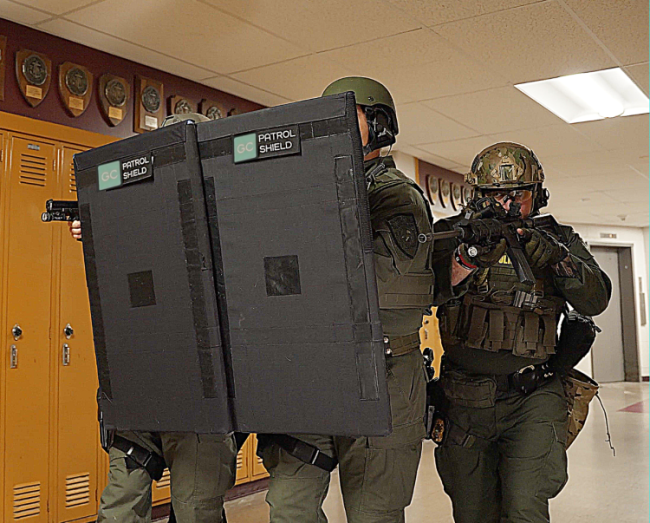
10 QUESTIONS YOUR TEAM SHOULD ASK WHEN BUYING BALLISTIC SHIELDS

Most procurement conversations start with the obvious questions. These are the ones that reveal what the specification sheet doesn’t.

For Law Enforcement | Chiefs & Command Staff | Procurement Officers
TL;DR:
  • This ballistic shield buying guide covers the questions most procurement conversations start with and the ones that reveal what the specification sheet doesn’t
  • Most teams ask about protection level, weight, and price. Those matter, but they do not distinguish between shields of meaningfully different real-world capability
  • The questions that reveal the most about a shield’s operational performance are the ones most procurement teams do not ask
  • This guide covers five questions every team asks, and five that reveal what the specification sheet does not

1. What level of protection does this shield provide?

The starting point for any ballistic shield evaluation. Protection level is defined by the NIJ rating, the standard that specifies which ammunition types and velocities a shield’s central panel has been tested to stop.

NIJ Level III indicates testing against rifle threats including 7.62x51mm M80 Ball NATO. NIJ Level III+ indicates an enhanced threat set. NIJ Level HG indicates handgun-rated protection.

What to know: NIJ rating establishes the baseline protection level. It confirms central panel performance under controlled laboratory conditions. It does not describe how the complete shield performs under edge impacts, concentrated fire, environmental stress, or oblique angles. Those require ASTM E3347-25 verification.

2. How much does it weigh, and how does that affect deployment?

Weight directly affects how long a shield can be held in position, how quickly it can be deployed, and how effectively an officer can maintain positioning during a sustained engagement. These are not comfort considerations, they are operational ones.

What to know: A conventional rifle-rated shield typically weighs 35 to 40 lb. GC Patrol Shield weighs 20 lb, half the weight, at the same protection level. The weight difference affects fatigue across every carry, drill, and deployment. Evaluate weight as a daily operational factor, not just a tactical one.

3. What size shield does my team need?

Larger shields offer more coverage but create more resistance in confined spaces, slower transitions, and increased fatigue over time. Smaller shields are more maneuverable but expose more of the officer’s body.

What to know: Evaluate size in the environments where the shield will actually be used. A shield that performs well in open ground may not work well in school corridors, stairwells, or vehicle exits. Consider whether a compact format, such as GC Compact Shield at 10 lb, is appropriate for vehicle-based deployment, where immediate access and rapid deployment from a cruiser are priorities.

4. How quickly can it be deployed in the field?

In a real incident, deployment speed matters. A shield that takes time to access, assemble, or bring into use reduces the effective response time.

What to know: Evaluate deployment speed in realistic conditions: from a vehicle, in a corridor, under time pressure. A shield stored in a location an officer cannot reach quickly is not providing protection. GC Compact Shield is designed to fit on the passenger seat of a cruiser for immediate access.

5. How durable is it, and what is the warranty?

A shield that degrades earlier than expected, requires frequent maintenance, or needs replacement ahead of schedule costs more over its service life than the purchase price suggests.

What to know: Warranty length reflects manufacturer confidence in the product’s long-term performance. GC Patrol Shield carries a 10-year warranty, double the industry standard of five years. Ask what the warranty covers, how claims are handled, and what the expected maintenance requirements are under regular operational use.

6. Has the shield been tested for edge protection, and what were the results?

Under NIJ 0108.01, shots within 2 inches of the shield’s edge are classified as unfair hits. They do not count toward the rating, and a perforation in that zone does not disqualify the shield. The edge of the shield, where different materials meet and where energy distribution is most constrained, has never been required to be tested under NIJ.

ASTM E3347-25 closes this gap. It requires shots placed in the band between the standard 2-inch minimum and 0.75 inches beyond it. Read more

What to ask: Has this shield been submitted for ASTM E3347-25 verification? Did it pass the edge shot requirement? If the answer is no to either question, the edge has not been independently tested.

7. Has it been tested for multi-hit performance in the same zone, and at what proximity?

NIJ testing requires shots to be spaced at least 2 inches apart across the strike face. Real engagements do not space impacts conveniently. A subject firing at an advancing officer is targeting the same zone repeatedly.

ASTM E3347-25 requires cluster shots: three rounds within a 3.94-inch (100mm) circle, at both zero degrees and 30 degrees. This tests concentrated fire in the same zone, on a shield that has already been conditioned through extreme temperatures and water immersion. Read more

What to ask: Has the shield been tested for cluster shot performance under ASTM E3347-25? At which angles? On a conditioned test item? NIJ multi-shot spacing and ASTM cluster shot spacing are materially different requirements.

8. Has it been tested after environmental conditioning?

Most ballistic shields are tested at room temperature, on a fresh product, under controlled laboratory conditions. Real shields are stored in patrol vehicles that reach 140°F in summer and drop below zero in winter. They are carried in rain. They cycle through temperature extremes across their service life.

ASTM E3347-25 requires two full conditioning sequences before ballistic testing begins: one ending at -60°F for at least six hours, one ending at 155°F for at least six hours, both including thermal shock cycling and water submersion. Ballistic testing must begin within 30 minutes of the shield being removed from conditioning. Read more

What to ask: Was the shield tested after environmental conditioning, or at room temperature on a fresh product? Has it been submitted for ASTM E3347-25 verification? These are different tests with different implications.

9. Does it protect at the fasteners and handle attachment points, and is handle operability a pass/fail requirement?

Handle attachment hardware passes into or through the ballistic material. Shots near that hardware create stresses that shots on an open panel do not. A shield that stopped the round but whose handle has been compromised by a near-fastener impact cannot be repositioned. In operational terms, the officer is now holding a fixed barrier, not a portable shield.

Under ASTM E3347-25, every structurally unique fastener is tested three ways: head shot, proximity shot, and angled shank shot. The handle must remain fully functional after every shot on the shield. This is a hard pass/fail criterion. Under NIJ, fastener testing is not required. Read more

What to ask: Has this shield been tested for fastener and handle integrity under ASTM E3347-25? Did the handle remain functional after all shots? If the answer is no to either, this scenario has not been independently tested.

10. What materials is it made of, and how does that affect long-term performance and weight?

Steel and ceramic are the traditional materials for rifle-rated ballistic shields. Both provide adequate ballistic performance in controlled conditions. Both are heavier per unit of protection than advanced composite materials.

Graphene composite construction achieves rifle-rated ballistic performance at significantly lower weight. This affects not just the carry burden, but also how the shield responds to impacts, distributing energy differently than steel or ceramic, and how it performs over repeated operational use and environmental exposure.

What to ask: What materials is the shield made of, and how do they affect weight, ballistic energy distribution, and long-term performance? Has the shield been tested after environmental conditioning that reflects real storage and deployment conditions?

How to Use These Questions in Practice

These questions are most effective when asked of all suppliers being evaluated, with documented answers required from each. A supplier who cannot answer from test documentation is asking you to trust claims without evidence.

The answers to questions 6 through 10 will typically distinguish between shields that have been tested to NIJ only and those that have been submitted for ASTM E3347-25 verification. That distinction matters.

For a detailed comparison of NIJ and ASTM standards, read ASTM vs NIJ Ballistic Shield Standards.

For a plain-language guide to what each standard covers, read Do You Know Your Ballistic Shield Standards?

GC Patrol Shield: What the Answers Look Like

Question GC Patrol Shield
Protection level NIJ Level III+ rated
Weight 20 lb: half the weight of conventional rifle-rated shields
Size options Full patrol shield (34.25 x 19.25 in.) and GC Compact Shield (17.25 x 19.5 in.)
Deployment GC Compact Shield fits on passenger seat of a cruiser for immediate access
Warranty 10 years: double the industry standard
Edge protection ASTM E3347-25 verified: edge shots required and passed
Multi-hit performance ASTM E3347-25 verified: cluster shots at 0 degrees and 30 degrees
Environmental conditioning ASTM E3347-25 verified: full conditioning sequences completed
Fastener and handle integrity ASTM E3347-25 verified: handle fully functional after every shot
Materials Graphene composite construction

Testing conducted by an independent, ISO/IEC 17025 qualified laboratory also qualified by NIJ, with results verified by the Safety Equipment Institute (SEI). The same commercial product sold since early 2024 passed verification with no modifications.

Learn more about GC Patrol Shield.

Key Takeaways

  • The five standard procurement questions – protection level, weight, size, deployment speed, durability – are necessary but not sufficient.
  • The five questions most teams do not ask – edge protection, multi-hit performance, environmental conditioning, fastener and handle integrity, and materials – reveal the most about real-world capability.
  • NIJ rating answers the protection level question. ASTM E3347-25 verification answers questions 6 through 9.
  • Ask for documented answers from independent testing, not manufacturer claims.
  • A shield that passes ASTM E3347-25 verification has been tested for the scenarios NIJ does not cover. That is a meaningful procurement differentiator.

GC Patrol Shield is NIJ Level III+ rated and ASTM E3347-25 verified, the most complete testing record available for a ballistic shield. Speak to the GC team or download the brochure to find out more.