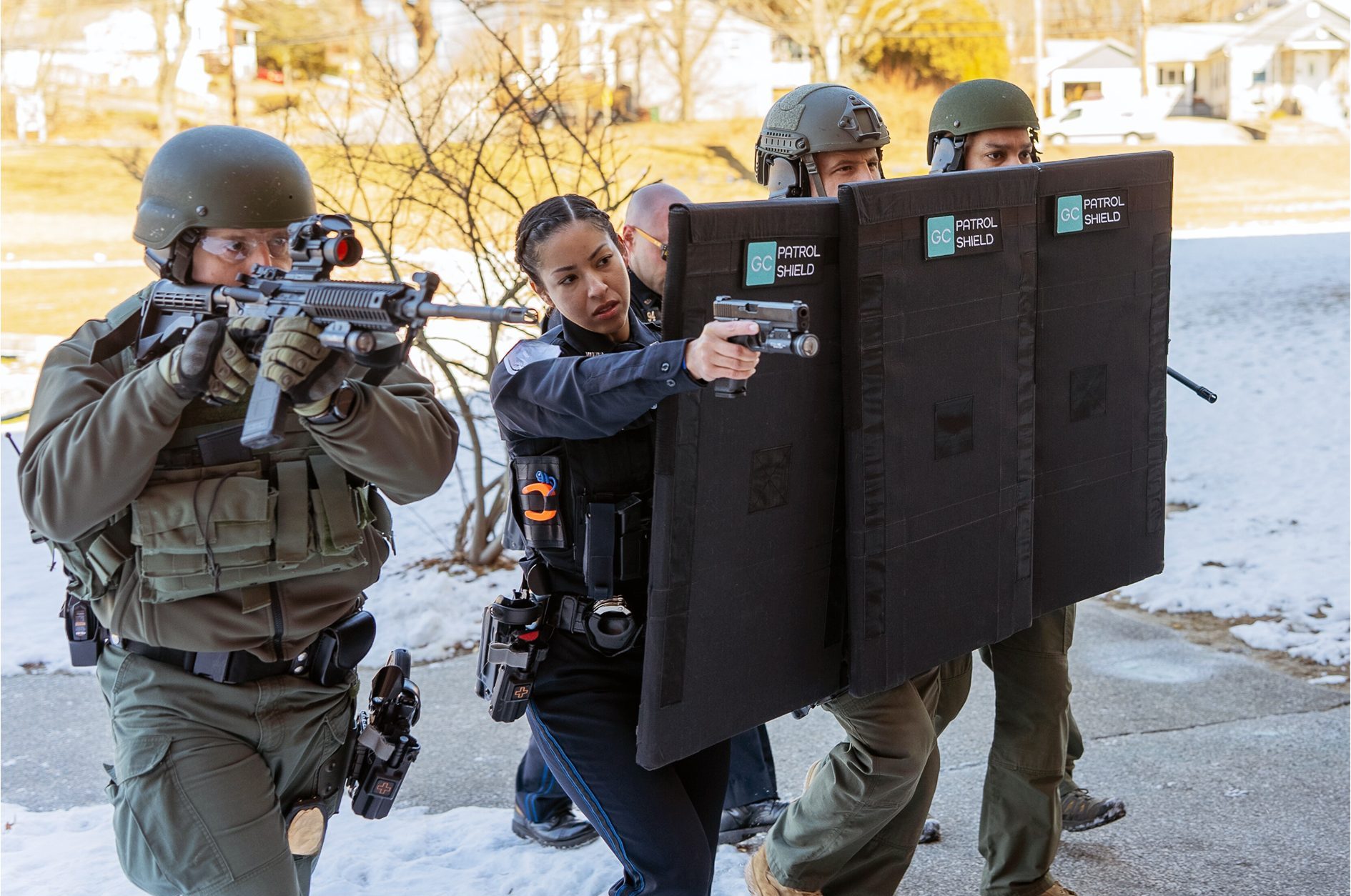
ASTM VS NIJ BALLISTIC STANDARDS: WHAT THEY TEST, WHAT THEY MISS, AND HOW TO USE THEM

NIJ establishes a protection level. ASTM tests whether the complete shield maintains it.

For Law Enforcement | Chiefs & Command Staff | Procurement Officers
TL;DR:
  • When comparing ASTM vs NIJ ballistic shield standards, NIJ 0108.01 is the established baseline. It evaluates whether a shield’s central panel stops defined ammunition types under controlled laboratory conditions
  • ASTM E3347-25 is a shield-specific standard built to test complete shields under real-world conditions, including environmental conditioning, edge shots, cluster impacts, fastener integrity, weak points, and angled shots
  • The two standards are not interchangeable. NIJ establishes a protection level. ASTM tests whether the complete shield maintains that protection across the conditions of deployment
  • GC Patrol Shield was the first rifle-rated shield to pass ASTM E3347-25 verification, and the only shield verified at both rifle and shotgun levels

1. What NIJ Ballistic Standards Are Designed to Measure

The National Institute of Justice (NIJ) standard for ballistic shields, NIJ 0108.01, was originally developed to provide law enforcement agencies with a consistent, repeatable method for evaluating ballistic materials. It defines protection levels, specifies ammunition types and velocities, and produces a pass/fail result under controlled laboratory conditions.

NIJ testing answers one question: does this shield’s central ballistic panel stop the specified round, fired straight at it from a fixed position, at room temperature?

What NIJ testing confirms:

  • The central panel meets minimum ballistic resistance against a defined threat
  • Performance is consistent and repeatable under controlled conditions
  • The shield meets a recognised protection level for compliance and procurement purposes

What NIJ testing does not confirm:

  • How the shield performs after exposure to temperature extremes or water
  • Whether the perimeter holds up under impact (shots within 2 inches of the edge are classified as unfair hits and do not count toward the rating)
  • How the shield behaves under concentrated fire in the same zone
  • Whether the handle remains functional after shots near the attachment hardware
  • How the material responds to impacts at angles other than zero degrees

A shield can carry a full NIJ rating and never have been tested for any of these scenarios.

2. What ASTM E3347-25 Is Designed to Measure

ASTM E3347-25 is a standard developed specifically for ballistic shields used by law enforcement. It was built around a different question: does the complete shield, not just the central panel, perform under the conditions of real deployment?

The standard requires two full conditioning sequences before ballistic testing begins. One sequence ends with the shield held at -60°F for a minimum of six hours. The other ends with the shield held at 155°F for a minimum of six hours. Both sequences also include thermal shock cycling and water submersion. Ballistic testing must be completed within 30 minutes of the shield being removed from conditioning.

The shield arriving at ballistic testing is not a fresh product. It is a shield that has already been through the kind of environmental stress it will experience in real service.

What ASTM E3347-25 tests that NIJ does not:

  • Temperature conditioning: extreme heat (155°F), extreme cold (-60°F), thermal shock cycling, and water immersion before any ballistic testing Read more
  • Edge shots: shots placed in the band between the standard minimum distance and 0.75 inches beyond it Read more
  • Cluster shots: three rounds within a 3.94-inch (100mm) circle, testing concentrated impacts on the same zone Read more
  • Angled shots: cluster shots at 30 degrees, testing oblique impact on every area of unique material construction
  • Fastener integrity: shots at fastener heads, in proximity to fastener shanks, and at 45 degrees toward the shank, covering every structurally unique fastener
  • Weak points: the manufacturer must declare all potential weak points before testing; the laboratory then targets each one Read more
  • Handle operability: after every shot, the shield handle must remain fully functional. A shield that cannot be repositioned after a hit is a failure

ASTM E3347-25 also defines five protection levels: HG2 (handgun), RF1, RF2, RF3 (rifle), and SG (shotgun). The shotgun level is an optional add-on verification for shields already rated at handgun or rifle level.

3. Key Differences Between NIJ and ASTM Testing

NIJ 0108.01 ASTM E3347-25
Designed for Ballistic materials Complete shield systems
Conditioning before testing Room temperature only Extreme heat, cold, thermal shock, water immersion
Edge shots Excluded: classified as unfair hits Required: in the band just beyond the exclusion zone
Multi-shot in same zone Shots spaced at least 2 inches apart Three rounds within a 3.94-inch circle
Angled impacts Zero degrees only Cluster shots at 30 degrees
Fastener testing Not required Head shot, proximity shot, and angled shank shot per unique fastener
Weak point testing Not required Manufacturer declares all weak points; lab targets each one
Handle operability Not assessed Pass/fail requirement after every shot
Result type Pass/fail rating Verified performance across complete test sequence

4. What Each Standard Validates Well

NIJ 0108.01 validates:

  • Baseline ballistic resistance of the central panel
  • Protection level for compliance and procurement reference
  • Consistency and repeatability under controlled conditions
  • Minimum safety thresholds for specified threats

ASTM E3347-25 validates:

  • Full-system performance of the complete shield
  • Ballistic integrity after real-world environmental stress
  • Perimeter protection, not just central panel performance
  • Structural integrity at hardware attachment points
  • Performance under concentrated and oblique fire

Used together, they give procurement teams the most complete picture available of how a shield is likely to perform in service.

5. Common Misunderstandings in Procurement

“NIJ rated means fully tested.”
NIJ rating confirms the central panel meets a defined protection level under controlled conditions. It does not cover edge performance, environmental degradation, fastener integrity, or angled impacts. These are tested under ASTM E3347-25.

“ASTM is optional, so it matters less.”
ASTM E3347-25 tests scenarios that NIJ explicitly excludes. A shield that has not been submitted for ASTM verification has not demonstrated its performance under those conditions, not because it passed, but because it was never tested.

“If it passed NIJ, it will perform in the field.”
NIJ testing takes place at room temperature, on a fresh shield, with shots spaced away from edges and hardware. Real deployment involves temperature cycling, concentrated fire, perimeter impacts, and angled shots. ASTM E3347-25 addresses each of these.

6. How Procurement Teams Should Use Both Standards

NIJ rating is the appropriate starting point for any shield evaluation. It establishes the protection level and provides a defensible compliance reference.

ASTM E3347-25 verification tells you whether the complete shield maintains that protection across the conditions of real use. It is not a replacement for NIJ, it is the next question after NIJ has been answered.

A sound evaluation process:

  • Confirm the NIJ rating and protection level for the intended threat environment
  • Check whether the shield has been submitted for ASTM E3347-25 verification, and if so, at which levels
  • Review test documentation from an independent, ISO-qualified laboratory
  • Assess design factors that ASTM testing addresses directly: viewport presence (viewports introduce additional fastener and interface test requirements), handle design, edge construction, and material joints
  • Conduct field evaluation alongside the testing data

Standards narrow the field and reduce procurement risk. They do not replace operational evaluation.

For a deeper look at what NIJ rating does and doesn’t confirm, read NIJ Level III Ballistic Shields: Why the Rating Isn’t Enough

For a detailed look at what ballistic testing validates, read What Ballistic Shield Testing Can and Can’t Tell You

For a broader introduction to ballistic shield standards, read Do You Know Your Ballistic Shield Standards?

7. What Buyers Should Ask Beyond the NIJ Rating

  • Has this shield been submitted for ASTM E3347-25 verification? At which protection levels?
  • What conditioning sequences were completed before ballistic testing?
  • What were the results of edge shot, fastener, weak point, and angled shot testing?
  • Was the shield tested as a complete, fully assembled product identical to what is sold in the marketplace?
  • Who conducted the testing, and are they an ISO/IEC 17025 qualified laboratory?
  • Did the handle remain functional throughout the test sequence?

If a supplier cannot answer these questions from documented test results, the data does not exist.

For a structured procurement framework, read our Ballistic Shield Buying Guide

8. What Neither Standard Fully Captures

Even together, NIJ and ASTM standards do not address every real-world variable:

  • Long-term wear from repeated handling, transport, and daily carry
  • Performance after minor physical damage accumulated in service
  • Human factors: fatigue, deployment speed, and coordination under stress
  • Integration with team tactics and operational environments

Testing validates performance under defined conditions. Field evaluation, user training, and operational feedback provide context that no standard can fully replicate.

GC Patrol Shield and ASTM E3347-25

GC Patrol Shield was the first rifle shield to pass ASTM E3347-25 verification, completing the full test sequence at both RF1 (rifle) and SG (shotgun) protection levels, the only shield to have achieved verification at both levels. Testing was conducted by an independent, ISO/IEC 17025 qualified laboratory also qualified by NIJ, with results subsequently verified by the Safety Equipment Institute (SEI).

The same commercial product sold to agencies since early 2024 passed verification with no modifications.

Learn more about GC Patrol Shield and ASTM E3347-25 verification.

Key Takeaways

  • NIJ 0108.01 establishes protection levels for the central ballistic panel under controlled conditions. It is the baseline for procurement compliance.
  • ASTM E3347-25 tests the complete shield, including edges, fasteners, weak points, angled impacts, and handle operability, after environmental conditioning. It tests what NIJ does not.
  • Edge shots are not included in NIJ testing. Shots within 2 inches of the shield edge are classified as unfair hits and do not count. ASTM requires shots in the band just beyond that zone.
  • Cluster shots, angled impacts, and fastener testing are ASTM requirements. They are not part of NIJ testing.
  • A shield’s NIJ rating and its ASTM verification status answer different questions. Procurement decisions are better informed when both are considered.

GC Patrol Shield is NIJ Level III+ rated and ASTM E3347-25 verified, the most complete testing record available for a ballistic shield. Speak to the GC team or download the brochure to find out more.