NIJ Level III Ballistic Shields: Why the Rating Isn’t Enough

NIJ Level III is where evaluation starts. Not where it ends.

For Law Enforcement | Chiefs & Command Staff | Tactical Teams
TL;DR:
  • NIJ Level III is a protection level, not a quality rating. It confirms a shield’s central panel stopped defined rifle rounds under controlled conditions. It does not describe usability, durability, edge performance, fastener integrity, or environmental resilience.
  • Two shields with identical NIJ ratings can perform differently in the field because of how they are engineered, what they weigh, how they handle, and what additional testing they have or have not been through.
  • ASTM E3347-25 verification addresses the gap: it tests complete shields under real-world conditions that NIJ does not cover.
  • A sound procurement decision uses NIJ rating as the entry filter, then asks what the shield has demonstrated beyond that baseline.

1. How NIJ Level III Became a Procurement Shortcut

NIJ protection levels were designed to give law enforcement agencies a consistent, comparable baseline for ballistic shield evaluation. Level III indicates a shield has been tested against specific rifle threats under defined laboratory conditions. It is a meaningful standard for that purpose.

Over time, in many procurement processes, the level rating has become shorthand for overall quality. If two shields both carry a Level III rating, the assumption is often that they offer equivalent protection and that price, or availability, or familiarity, can decide between them.

That assumption is worth examining.

2. What NIJ Level III Confirms

NIJ Level III rating confirms a shield’s central ballistic panel stopped specified rifle rounds, including 7.62x51mm M80 Ball NATO, fired at defined velocities, under controlled laboratory conditions, at room temperature, at zero degrees angle of incidence.

What it confirms:

  • The central panel meets minimum ballistic resistance against defined threats
  • Performance is consistent and repeatable under the test conditions
  • The shield meets a recognised compliance threshold

What it does not confirm:

  • How the shield performs after temperature extremes, patrol vehicles regularly reach 140°F in summer and sub-zero temperatures in winter Read more
  • Whether the perimeter holds under impact, shots within 2 inches of the edge are classified as unfair hits under NIJ and do not count Read more
  • How the shield behaves under concentrated fire in the same zone Read more
  • Whether handle hardware survives shots near the attachment points Read more
  • How the material responds to impacts at angles other than zero degrees
  • How the shield performs after years of daily carry, transport, and handling
  • Whether the shield can be held in position effectively during a sustained engagement

A shield with a NIJ Level III rating has passed a specific test. It has not been evaluated for most of the conditions an officer is likely to encounter.

3. Why Identical Ratings Can Mean Very Different Shields

NIJ Level III sets a floor, not a ceiling. Two shields that both pass the same test can differ significantly in the factors that determine real-world performance.

Material composition. UHMWPE composites, steel, and ceramic all stop rounds through different mechanisms and respond differently to temperature cycling, repeated handling, and edge impacts. A rating number does not describe how the material behaves under the conditions of deployment.

Weight and weight distribution. A shield that weighs 40 lb and a shield that weighs 20 lb can carry the same NIJ rating. The heavier shield increases fatigue, reduces maneuverability, and affects how long an officer can maintain effective positioning. NIJ testing uses a fixed mounting system. The officer carrying the shield is not fixed.

Edge construction. The perimeter of a shield is where different materials meet and where energy distribution is most constrained. Two shields with identical central panel ratings may have very different edge designs and only ASTM E3347-25 requires testing close to the edge.

Handle and fastener design. Handle attachment hardware passes into or through the ballistic material. Shots near hardware create a different set of stresses than shots on an open panel. NIJ does not require fastener shots. ASTM E3347-25 does, three shot types per unique fastener.

Viewport presence. A shield with a transparent viewport has additional interfaces, between the glazing material and the shield body, that represent potential weak points. ASTM E3347-25 requires viewport interface testing. NIJ does not.

Warranty. A 5-year warranty and a 10-year warranty on identically rated shields reflect different levels of manufacturer confidence in long-term material performance. The rating does not capture this.

4. The Operational Factors a Rating Cannot Describe

Beyond ballistic performance, the factors that determine whether a shield is effective in real use sit entirely outside what NIJ Level III measures.

Fatigue and endurance. An officer advancing behind a shield in an active shooter response may be carrying it for an extended period before contact. A shield that performs well in a 30-second demonstration may feel very different after ten minutes of movement through a building. Weight, balance, and handle design all affect endurance. None of these appear in a rating.

Deployment speed. How quickly a shield can be brought into use from a vehicle or storage position matters in time-critical scenarios. The rating does not address this.

Mobility in confined spaces. Corridors, stairwells, doorframes, and vehicle exits all create constraints. A larger, heavier shield may offer more coverage but create more friction in confined movement. A lighter, more compact shield may be more practical in the environments SROs and patrol officers operate in.

Integration with team tactics. How a shield attaches to others in a shield wall configuration, how it integrates with communication, and how it affects team movement all affect operational effectiveness. None of this is in the rating.

5. What Should Accompany a NIJ Rating in Evaluation

NIJ Level III is the appropriate starting point. It confirms the baseline protection level and narrows the field of compliant options. The question is what comes next.

ASTM E3347-25 verification answers questions NIJ does not ask. Has the shield been conditioned through temperature extremes before testing? Has the handle demonstrated it remains functional under fire? Have fasteners and weak points been targeted? Has the shield been tested at oblique angles?

A shield that carries both NIJ Level III+ rating and ASTM E3347-25 verification has a more complete testing record than one rated under NIJ alone. That difference is worth understanding before a procurement decision is made.

Independent laboratory testing. Testing should be conducted by an ISO/IEC 17025 qualified laboratory, independent of the manufacturer. For ASTM E3347-25, the same laboratory can hold both NIJ and ASTM qualification, which provides a single, credible, independent testing record.

Field evaluation. Testing data narrows options. Field evaluation, live handling, realistic drills, extended carry, reveals what test data cannot: how the shield feels and functions in the hands of the officers who will use it.

Manufacturer transparency. A supplier who can provide full test documentation, explain the engineering decisions behind the product, and specify the limitations of their shield demonstrates a level of transparency that is itself a procurement signal. Certifications should be supported by evidence, not substituted for it.

For a detailed look at what ballistic shield testing does and doesn’t validate, read What Ballistic Shield Testing Can and Can’t Tell You.

For a detailed comparison of NIJ and ASTM testing, read our guide to ASTM vs NIJ ballistic standards.

For a broader introduction to ballistic shield standards, read Do You Know Your Ballistic Shield Standards?

For a structured procurement framework, read our Ballistic Shield Buying Guide

6. How NIJ Level III Should Be Used in Practice

As an entry filter. Use the NIJ rating to confirm a shield meets the protection level required for the threat environment. Remove from consideration any shield that does not meet the minimum rating.

Not as the deciding factor. Within the compliant field, NIJ rating alone does not distinguish meaningfully between products. Two shields with the same rating may differ significantly in weight, edge performance, fastener integrity, environmental resilience, and usability.

Alongside ASTM E3347-25 verification. Ask whether each candidate shield has been submitted for ASTM E3347-25 verification, and at which protection levels. If it has not been submitted, ask why. If it has been submitted and not passed, understand what that means for the scenarios the standard covers.

Alongside operational evaluation. Testing data and field performance are complementary. Procurement decisions that rely on ratings alone risk selecting equipment optimised for a test rather than for real operational use.

NIJ Level III rating does:

  • Confirm the central panel stops specified rifle rounds under controlled conditions
  • Provide a compliance reference for procurement and accountability
  • Enable initial screening across a large product field
  • Establish a minimum protection threshold for defined threats

NIJ Level III rating doesn’t:

  • Predict performance under temperature extremes, concentrated fire, edge impacts, or oblique shots
  • Describe usability, weight, balance, or fatigue effects
  • Confirm handle or fastener integrity under ballistic impact
  • Account for long-term wear and material ageing
  • Distinguish between shields of meaningfully different real-world capability
  • Replace professional judgement and operational evaluation

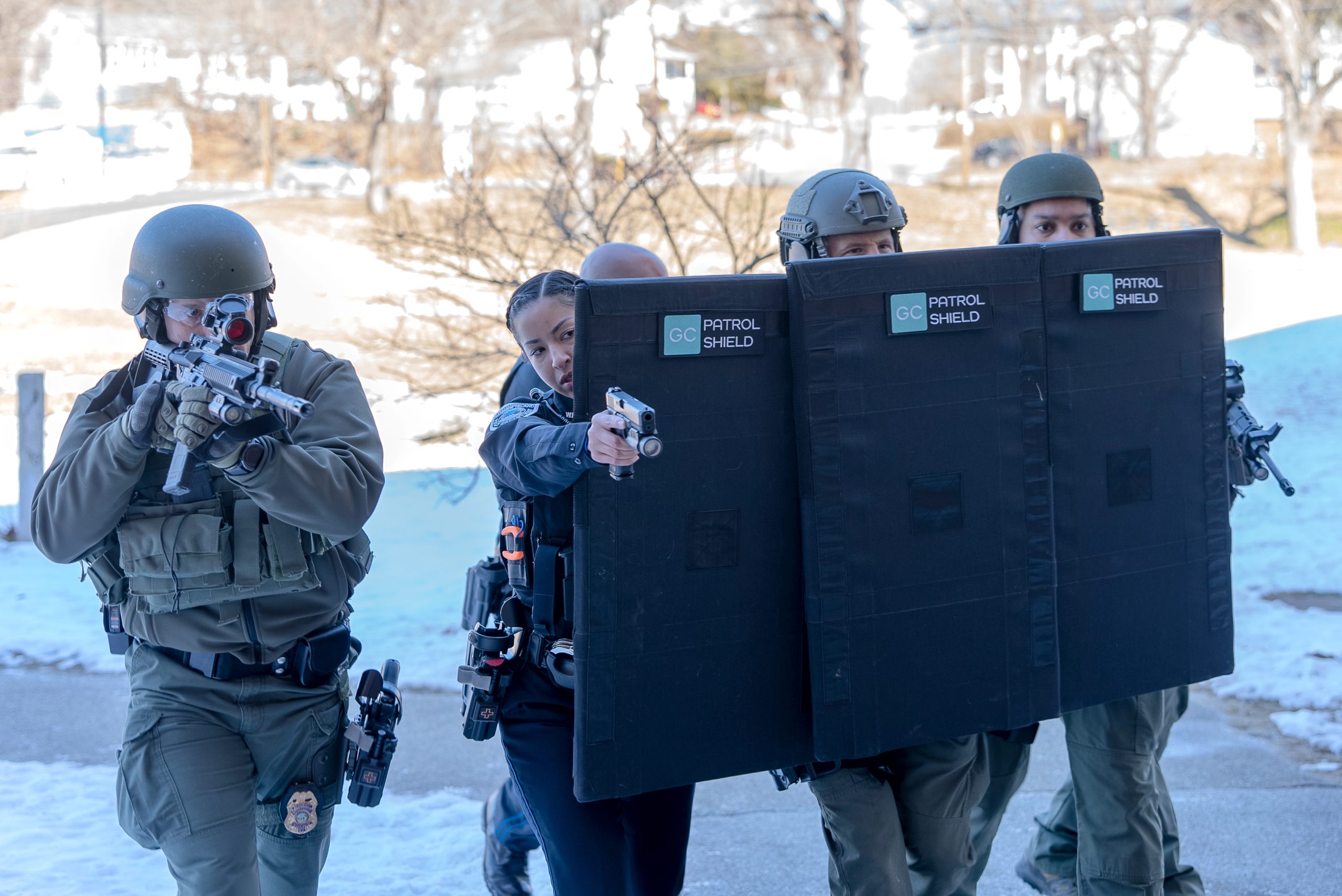
GC Patrol Shield: Beyond the NIJ Baseline

GC Patrol Shield is NIJ Level III+ rated, meaning it meets and exceeds the standard NIJ rifle protection requirement. It has also passed ASTM E3347-25 verification at both RF1 (rifle) and SG (shotgun) levels, making it the first rifle shield to pass the full ASTM test sequence and the only shield verified at both levels.

At 20 lb, it is half the weight of conventional rifle-rated shields. Its graphene composite construction has no transparent viewport, eliminating the viewport interface as a potential weak point. It carries a 10-year warranty, double the industry standard. Testing was conducted by an independent, ISO/IEC 17025 qualified laboratory also qualified by NIJ, with results verified by the Safety Equipment Institute (SEI).

The shields agencies are purchasing are the same commercial product that passed testing. No modifications were made.

Learn more about GC Patrol Shield.

Key Takeaways

  • NIJ Level III rating confirms central panel performance under controlled conditions. It is a protection level, not a comprehensive quality rating.
  • Two shields with identical NIJ ratings can differ significantly in weight, edge performance, fastener integrity, environmental resilience, and usability. None of which NIJ testing measures.
  • Edge shots, cluster shots, fastener testing, weak point testing, angled shots, and handle operability are ASTM E3347-25 requirements. They are not part of NIJ Level III testing.
  • NIJ rating is the correct starting point for ballistic shield procurement. It is not sufficient on its own to distinguish between shields of meaningfully different real-world capability.
  • ASTM E3347-25 verification, field evaluation, and manufacturer transparency complete the picture that NIJ rating alone cannot provide.

GC Patrol Shield is NIJ Level III+ rated and ASTM E3347-25 verified, the most complete testing record available for a ballistic shield. Speak to the GC team or download the brochure to find out more.