DO YOU KNOW YOUR BALLISTIC STANDARDS? A PLAIN-LANGUAGE GUIDE TO NIJ AND ASTM TESTING

Understanding what each standard tests, and what it doesn’t, is what turns a rating number into meaningful information.

For Law Enforcement | Chiefs & Command Staff | Procurement Officers
TL;DR:
  • NIJ 0108.01 is the established baseline for ballistic shield standards in law enforcement. It defines protection levels and tests the central panel under controlled conditions
  • ASTM E3347-25 is a  standard that goes further, testing complete shields after environmental conditioning, including edge shots, cluster impacts, fastener integrity, weak points, and angled shots
  • NIJ and ASTM test different things. A shield with a NIJ rating has demonstrated central panel performance. A shield with ASTM E3347-25 verification has demonstrated full-system performance under real-world conditions
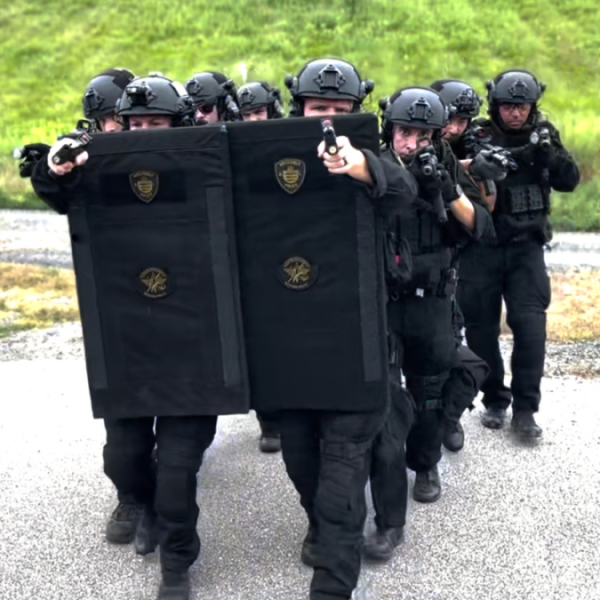
  • GC Patrol Shield is NIJ Level III+ rated and ASTM E3347-25 verified, the first rifle shield to pass, and the only shield verified at both rifle and shotgun level

1. Why Ballistic Standards Matter

When an officer carries a ballistic shield into an active shooter response or a barricaded subject incident, the decisions that determine whether that shield will hold were made long before the incident: in the lab, during testing, and in the procurement office.

Ballistic standards exist to make those decisions defensible. They provide a shared language for comparing shields, a documented basis for procurement decisions, and independent evidence that a shield performs as claimed.

Understanding what each standard actually tests, and what it does not, is what turns a rating number into meaningful information.

2. NIJ Standards: The Established Baseline

The National Institute of Justice (NIJ) has set the benchmark for ballistic shield performance in law enforcement for decades. The current standard, NIJ 0108.01, defines protection levels, including NIJ Level III and Level III+, based on the shield’s ability to stop specified ammunition types at defined velocities.

What NIJ testing covers:

  • Ballistic resistance of the central strike face against defined threats
  • Pass/fail performance under controlled laboratory conditions at ambient temperature
  • Consistency and repeatability across test items

What NIJ protection levels mean:

  • NIJ Level III: tested against rifle threats including 7.62x51mm M80 Ball NATO
  • NIJ Level III+: tested against an enhanced set of rifle threats beyond the Level III requirement
  • NIJ Level HG: tested against handgun threats

What NIJ testing does not cover:

  • How the shield performs after exposure to temperature extremes, shields are tested at room temperature only
  • Edge performance, shots landing within 2 inches of the shield’s perimeter are classified as “unfair hits” under NIJ and do not count toward the rating
  • Concentrated fire in the same zone, NIJ requires shots to be spaced at least 2 inches apart
  • Fastener integrity, shots near handle mounts and attachment hardware are not required
  • Oblique impacts, all NIJ shots are fired at zero degrees
  • Handle operability after shots

This is not a criticism of NIJ. The standard was designed to evaluate ballistic materials consistently and repeatably. It does that well. The limitation is that material performance under ideal conditions is not the same as complete shield performance under operational conditions.

3. ASTM E3347-25: Built for Complete Shields

ASTM E3347-25 is a standard developed specifically for ballistic shields used by law enforcement. Where NIJ tests a material, ASTM tests a complete shield system, including everything attached to it and everything that might be struck in a real engagement.

What makes ASTM E3347-25 different:

Environmental conditioning before ballistic testing. Before a single round is fired, shields must complete two full conditioning sequences. One ends with the shield held at -60°F for at least six hours. The other ends at 155°F for at least six hours. Both include thermal shock cycling and full water submersion. Ballistic testing must begin within 30 minutes of the shield being removed from conditioning. The shield being tested is not fresh from the box, it has been through the kind of environmental stress it will face in real service. Read more

Edge shots. ASTM requires shots placed in the band between the standard 2-inch minimum and 0.75 inches beyond it, directly targeting the perimeter zone that NIJ excludes. The edges of a shield are where the engineering is hardest and where different materials meet. ASTM tests them. NIJ does not. Read more

Cluster shots. Three rounds fired within a 3.94-inch (100mm) circle, at zero degrees and at 30 degrees. This tests what happens when fire concentrates in the same zone, a scenario NIJ’s shot-spacing requirements deliberately avoid. Read more

Fastener testing. Every structurally unique fastener is shot three ways: a head shot at zero degrees, a proximity shot within 20mm of the shank, and an angled shank shot at 45 degrees. Handle attachment hardware within the minimum shot-to-edge distance must be tested before any other shots on that test item.

Weak point testing. The manufacturer must declare all potential weak points before testing begins: perimeter corners, cutouts, protrusions, seams, folds, and joints. The laboratory then targets each one. Weak points are shot regardless of any obstruction: if a light or attachment is in front of a weak point, the laboratory shoots through it. Read more

Handle operability. After every shot on a shield test item, the handle must remain fully functional, the shield must be repositionable back to its intended use position. This is a hard pass/fail criterion, not a note in the test report.

Angled shots. Cluster shots at 30 degrees on every area of unique material construction test oblique impacts, the angle at which rounds are most likely to arrive when an officer is advancing, turning, or repositioning behind a shield.

4. NIJ and ASTM: What Each Standard Is Good At

NIJ 0108.01 ASTM E3347-25
Central panel performance ✓ Tests thoroughly ✓ Tests as part of full sequence
Environmental conditioning ✗ Room temperature only ✓ Extreme heat, cold, shock, submersion
Edge shots ✗ Excluded as unfair hits ✓ Required in band beyond exclusion zone
Cluster shots ✗ Shots spaced 2 inches apart ✓ Three rounds within a 3.94-inch circle
Angled impacts ✗ Zero degrees only ✓ Cluster shots at 30 degrees
Fastener testing ✗ Not required ✓ Three shot types per unique fastener
Weak point testing ✗ Not required ✓ Manufacturer declares; lab targets each
Handle operability ✗ Not assessed ✓ Pass/fail after every shot

5. What This Means for Your Agency

A shield’s NIJ rating tells you what protection level it has been tested to achieve, under controlled conditions, on the central strike face. That is important information for compliance and baseline comparison.

A shield’s ASTM E3347-25 verification tells you whether the complete shield (edges, fasteners, weak points, handle, etc) maintains that performance after the environmental stresses of real deployment, under concentrated fire, at the angles real engagements produce.

When evaluating shields, ask:

  • What is the NIJ protection level, and does it cover the threats this agency faces?
  • Has the shield been submitted for ASTM E3347-25 verification?
  • If so, at which protection levels? Rifle, handgun, shotgun?
  • Was testing conducted by an independent, ISO/IEC 17025 qualified laboratory?
  • Was the shield tested as the same product sold in the marketplace, with no modifications?
  • Did the handle remain functional throughout the test sequence?

If a supplier cannot provide documented answers to these questions, the data does not exist.

For a detailed comparison of the two standards, read ASTM vs NIJ Ballistic Shield Standards: What They Test and How to Use Them

For a deeper look at what NIJ rating does and doesn’t confirm, read NIJ Level III Ballistic Shields: Why the Rating Isn’t Enough

For a structured procurement framework, read our Ballistic Shield Buying Guide

6. What Ballistic Standards Do (and Don't) Tell You

Standards do:

  • Confirm a shield meets minimum ballistic performance requirements
  • Provide a documented, defensible basis for procurement decisions
  • Enable meaningful comparison between shields at the same protection level
  • Identify shields that have been tested beyond the NIJ baseline

Standards don’t:

  • Predict performance in every real-world scenario
  • Account for long-term wear, handling damage, or component ageing
  • Replace operational field evaluation and user feedback
  • Guarantee outcomes in dynamic, high-stress engagements
  • Substitute for training in how to deploy and use the shield effectively

Standards are the starting point for an informed procurement decision, not the end of it.

GC Patrol Shield: NIJ Rated and ASTM Verified

GC Patrol Shield is NIJ Level III+ rated and ASTM E3347-25 verified at both RF1 (rifle) and SG (shotgun) protection levels. The first rifle shield to pass the full ASTM E3347-25 test sequence, and the only shield verified at both levels.

At 20 lb, it is half the weight of conventional rifle-rated shields. It carries a 10-year warranty, double the industry standard. Testing was conducted by an independent, ISO/IEC 17025 qualified laboratory also qualified by NIJ, with results verified by the Safety Equipment Institute (SEI). The same commercial product sold since early 2024 passed testing with no modifications.

Find out more about GC Patrol Shield and ASTM E3347-25 verification.

Key Takeaways

  • NIJ 0108.01 defines protection levels and tests central panel performance under controlled conditions. It is the baseline for law enforcement procurement compliance.
  • ASTM E3347-25 tests complete shields after environmental conditioning, including edge shots, cluster impacts, fastener integrity, weak point shots, angled impacts, and handle operability. These are not part of NIJ testing.
  • Edge shots are excluded from NIJ testing. ASTM requires shots in the band just beyond that zone.
  • Cluster shots and angled impacts are ASTM requirements, not NIJ requirements.
  • A shield’s NIJ rating and its ASTM E3347-25 verification status answer different questions. The most complete procurement picture uses both.

GC Patrol Shield is NIJ Level III+ rated and ASTM E3347-25 verified, the most complete testing record available for a ballistic shield. Speak to the GC team or download the brochure to find out more.